

Dr Megan Shelden
Senior Lecturer
School of Agriculture, Food and Wine
College of Science
Eligible to supervise Masters and PhD as Principal Supervisor - email supervisor to discuss availability.
Megan is a Senior Mortlock Fellow at the Waite Campus, Adelaide University. She is a plant molecular physiologist whose research aims to improve crop productivity in challenging soils, such as those affected by salinity and drought. Her research combines root biology, plant physiology, molecular biology and functional genomics to understand how crop roots respond to soil stress. Using barley as a model cereal crop, she aims to identify genes and traits that can be translated into crop improvement.
Soil salinity affects an estimated 5.7 million hectares of land in Australia and costs the agricultural industry ~ $1.5 billion annually. To address this challenge, Megan’s research focuses on understanding how plants sense and respond to challenging soil environments below ground. Plant roots have a remarkable ability to adapt to stressful conditions such as salinity, while continuing to grow. Megan investigates the molecular and physiological mechanisms underlying these adaptations, with the aim of improving water and nutrient uptake in crops.
She collaborates with researchers across Australia and internationally, including collaborators at the University of Nottingham, Shanghai Jiao Tong University and the Australian Wine Research Institute, to investigate the mechanisms underlying crop resilience to environmental stress. Integrating molecular genetics, physiology and advanced root phenotyping, her research uncovers the mechanisms that enable crops to thrive in challenging soil environments.
Megan has contributed to securing more than $6.7 million in nationally competitive research funding from the Australian Research Council (ARC) and Grains Research and Development Corporation (GRDC). She has published extensively in leading journals, including The Plant Journal and Journal of Experimental Botany. Through her research, teaching and leadership, she is committed to advancing sustainable agriculture and improving crop resilience to support future food security.
Her long-term goal is to identify root traits and signalling pathways that can be translated into breeding programs to improve crop productivity and food security under increasingly challenging environmental conditions.
Current Research
Our research spans three complementary themes that seek to understand how plants sense, respond and adapt to environmental stress.
Understanding root traits to improve crop resilience
Our research seeks to understand the molecular and physiological mechanisms that enable crop root systems to adapt to challenging soil environments such as salinity and drought. Using barley as a model cereal crop, we investigate how root growth is regulated under stress to identify novel root architectural traits that improve water and nutrient uptake, enhance crop development, and increase yield.
Recognising the importance of studying root responses in their natural soil environment, we use advanced three-dimensional (3D) X-ray computed tomography imaging techniques to phenotype root systems in soil. These approaches allow us to investigate how crop root system architecture changes in response to soil stress. One example is xerobranching – a developmental response in which plants suppress lateral root formation when growing through air-filled soil pores, enabling roots to respond to local water availability.
Our research is expanding into the study of root-derived signalling molecules, including volatile organic compounds and plant hormones, to understand how roots perceive and respond to environmental stress. By integrating molecular biology, advanced root phenotyping and stress physiology, we aim to identify candidate genes and root traits that can be incorporated into breeding programs to develop more resilient, higher-yielding crops.
https://www.frontiersin.org/articles/10.3389/fpls.2023.1120583/full
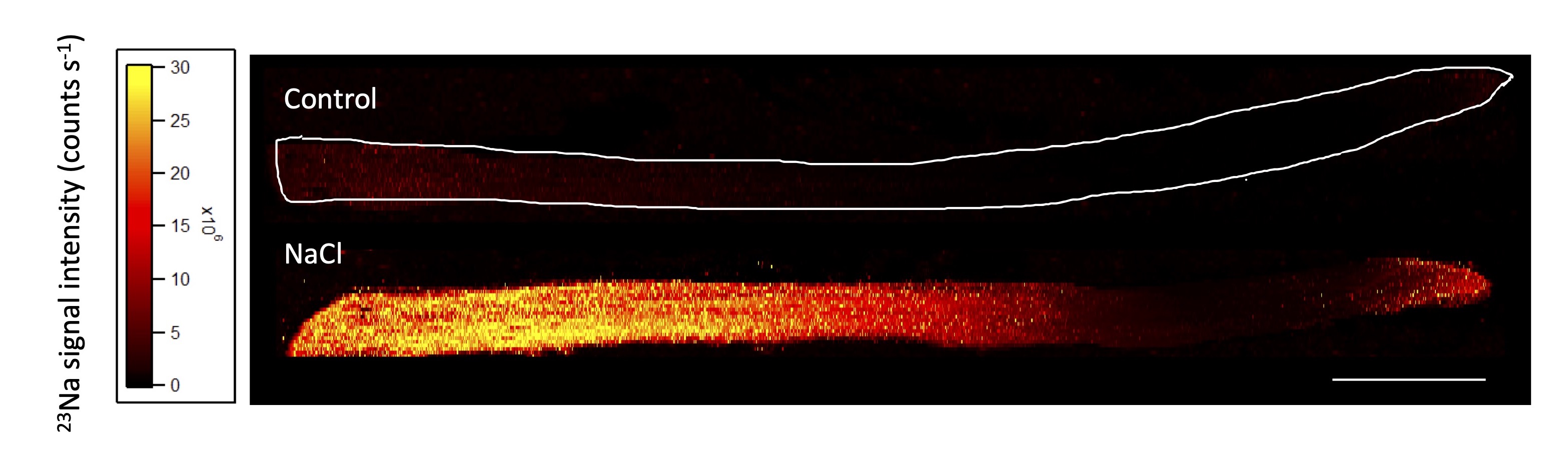
Salt-tolerance in Grapevines
Grapevines, a major horticultural crop for table grapes and wine production, are moderately sensitive to soil salinity. We use grapevine as a model system to understand the movement of salt (sodium and chloride) and water through the plant, from root to shoot. Our research aims to determine how salt moves through different tissues, how it accumulates in roots, leaves, and shoots, and how these processes are regulated by different membrane transport proteins. Understanding these transport mechanisms will help identify traits that improve salinity tolerance and water-use efficiency in grapevines and other horticultural crops.
https://www.sciencedirect.com/science/article/pii/S0981942826001427
Water and Ion Transport in Plants Under Environmental Stress
Plants rely on specialised proteins called aquaporins to move water across cell membranes. While aquaporins are best known for their role in water movement, some can also transport important nutrient ions as well as toxic sodium ions. Our research investigates how these proteins regulate the movement of water and ions within crop plants, particularly under saline and drought conditions. This work will provide novel insights into how plants coordinate and adapt to changing water and salt conditions, addressing a key gap in our understanding of how water and ions move into and out of plant vacuoles. These discoveries will identify new targets for breeding crops with improved water use efficiency, salt tolerance and resilience to climate change.
Lab Group
Current Staff
Dr. Sara Jalali (Research Assistant, GRDC project)
Ms. Daisy Edwards (Research Assistant, GRDC project)
Current Students
Ms. Zhale Hekmati
Ms. Iza Fatima
Mr. Caoyang Wang (co-supervisor)
Completed Students
Dr. Ying Meng
Dr. Apriadi Situmorang (Post-doc at AU)
Previous Staff
Dr. Yue Wu (Postdoctoral Fellow, now at PSBA)
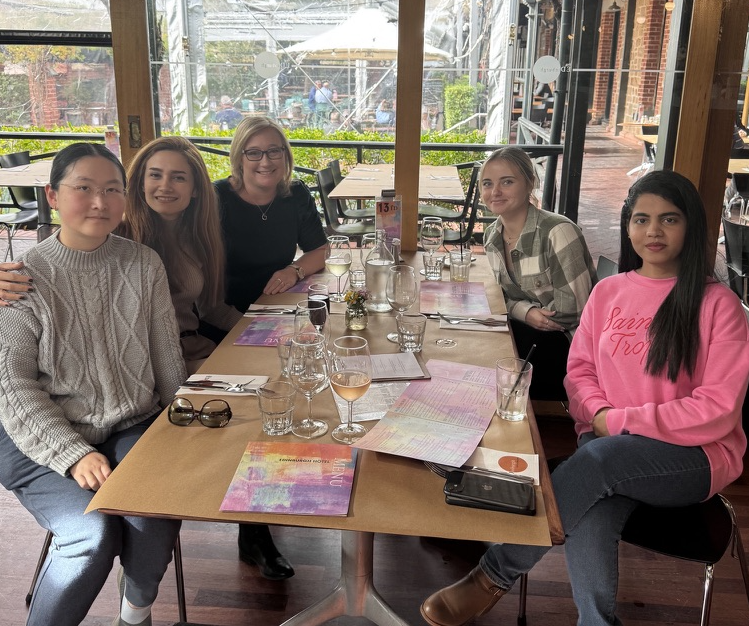
(Left to right): Yue (Crystal) Wu, Zhale Hekmati, Megan Shelden, Daisy Edwards, Iza Fatima
Research in the news:
Radio interview with ABC rural:
https://www.abc.net.au/news/rural/2015-12-11/sheldon-saline-wheat/7018212
Teaching, mentoring and outreach
Beyond her research, Megan is an active member of the Australian Society of Plant Scientists (ASPS), where she has served as a discipline representative and contributed to the establishment of the Society’s Gender, Equity and Diversity policy. She is passionate about educating and mentoring the next generation of plant and agricultural scientists through her teaching, research supervision, and mentoring at Adelaide University.
Megan is committed to promoting STEM (Science, Technology, Engineering, and Mathematics) through community engagement, including events such as National Science Week and the Royal Adelaide Show. In recognition of these efforts, she received the 2022 ASPS Education and Outreach Award. She founded the Women in Crop Science network at the Waite campus to support and connect women in plant and agriculture sciences.
I am recruiting Honours, Masters, and PhD students to work on aspects of the various projects listed above. If interested, please contact Megan directly with an expression of interest and CV (megan.shelden@adelaide.edu.au).
| Date | Position | Institution name |
|---|---|---|
| 2022 - ongoing | Senior Lecturer/ Mortock Fellow | University of Adelaide |
| 2020 - 2021 | Lecturer | The University of Adelaide |
| 2019 - 2020 | Research Fellow | The University of Adelaide |
| 2014 - 2019 | ARC DECRA Fellow | University of Adelaide |
| 2009 - 2013 | Research Fellow | University of Melbourne |
| 2007 - 2009 | Postdoctoral Fellow | Australian National University |
| Date | Institution name | Country | Title |
|---|---|---|---|
| 2023 | Deakin University | Australia | Graduate Certificate in Higher Education (Learning and Teaching) |
| 2008 | University of Adelaide | Australia | PhD |
| 1994 - 1997 | University of Adelaide | Australia | Bachelor of Science (Honours) |
| Year | Citation |
|---|---|
| 2019 | Tyerman, S., Munns, R., Fricke, W., Arsova, B., Barkla, B., Bose, J., . . . Wen, Z. (2019). Energy costs of salinity tolerance in crop plants. In New Phytologist Vol. 221 (pp. 25-29). UK: Wiley. DOI Scopus61 WoS53 Europe PMC39 |
| 2002 | Loughlin, P., Shelden, M. C., Tierney, M. L., & Howitt, S. M. (2002). Structure and function of a model member of the SulP transporter family. In Cell Biochemistry and Biophysics Vol. 36 (pp. 183-190). AUSTRALIA, COOLANGATTA: HUMANA PRESS INC. DOI Scopus14 WoS13 Europe PMC13 |
College of Science EMCR Travel Grant (2026), Adelaide University, $7600
Grains Research and Development Corporation (2025-2026); Establishing a new paradigm for salinity tolerance in cereals, $222,760
Charlick Endowment Fund (2025); University of Adelaide, $14,700
Research Small Equipment Support Scheme (2024), University of Adelaide, $11,000
UoA-UoN Seed Partnering Grant (2024), University of Adelaide, $10,000
Barbara Kidman Women's Fellowship (2024), University of Adelaide, $30,000
ARC Discovery Project (2022 - 2025); Finding the missing links in salt and water transport in plants, $489,236
ARC Discovery Project (2020 - 2023); Root-to-shoot: modeling the salt stress response of a plant vascular system, $420,000
ARC DECRA Fellow (2014 - 2017); Getting to the root of salt-tolerance in the model cereal crop, barley, $394,570
PRIF Catalyst Research Grant (2015 - 2016); Screening for salt-tolerance in wheat using impedance spectroscopy: A novel technique to reveal performance of the hidden half, $30,000
I contribute to teaching in:
Foundations in Plant Science II
Viticulture II /A
| Date | Role | Research Topic | Program | Degree Type | Student Load | Student Name |
|---|---|---|---|---|---|---|
| 2026 | Principal Supervisor | Molecular Gene Regulatory Networks Underlying Root Salinity Tolerance in Barley and Cereal Crops | Doctor of Philosophy | Doctorate | Full Time | Miss Xiaoyue Zhu |
| 2025 | Co-Supervisor | Evaluating the resilience of emerging winegrape cultivars in Australian vineyards to multiple abiotic stresses | Doctor of Philosophy | Doctorate | Full Time | Mr Caoyang Wang |
| 2024 | Principal Supervisor | Characterization of hydrotropism in crop plants using barley as a model system | Doctor of Philosophy | Doctorate | Full Time | Ms Iza Fatima |
| 2023 | Principal Supervisor | Finding the Missing Links in Salt and Water Transport in Plants | Doctor of Philosophy | Doctorate | Full Time | Ms Zhale Hekmati |
| Date | Role | Research Topic | Program | Degree Type | Student Load | Student Name |
|---|---|---|---|---|---|---|
| 2017 - 2023 | Co-Supervisor | The Role of GABA in Plant Salinity and Hypoxia Responses | Doctor of Philosophy | Doctorate | Full Time | Miss Ying Meng |
| 2015 - 2019 | Co-Supervisor | Elucidation of the Ammonium Major Facilitator (AMF) Family in Plants | Doctor of Philosophy | Doctorate | Full Time | Mr Apriadi Situmorang |
| Date | Role | Committee | Institution | Country |
|---|---|---|---|---|
| 2017 - 2019 | Representative | Australian Society of Plant Scientists Executive | Discipline Cell Biology | Australia |
| Date | Role | Membership | Country |
|---|---|---|---|
| 2015 - ongoing | - | Society of Experimental Biology | - |
| 1998 - ongoing | Member | Australian Society of Plant Scientists | - |
Connect With Me


External Profiles

