
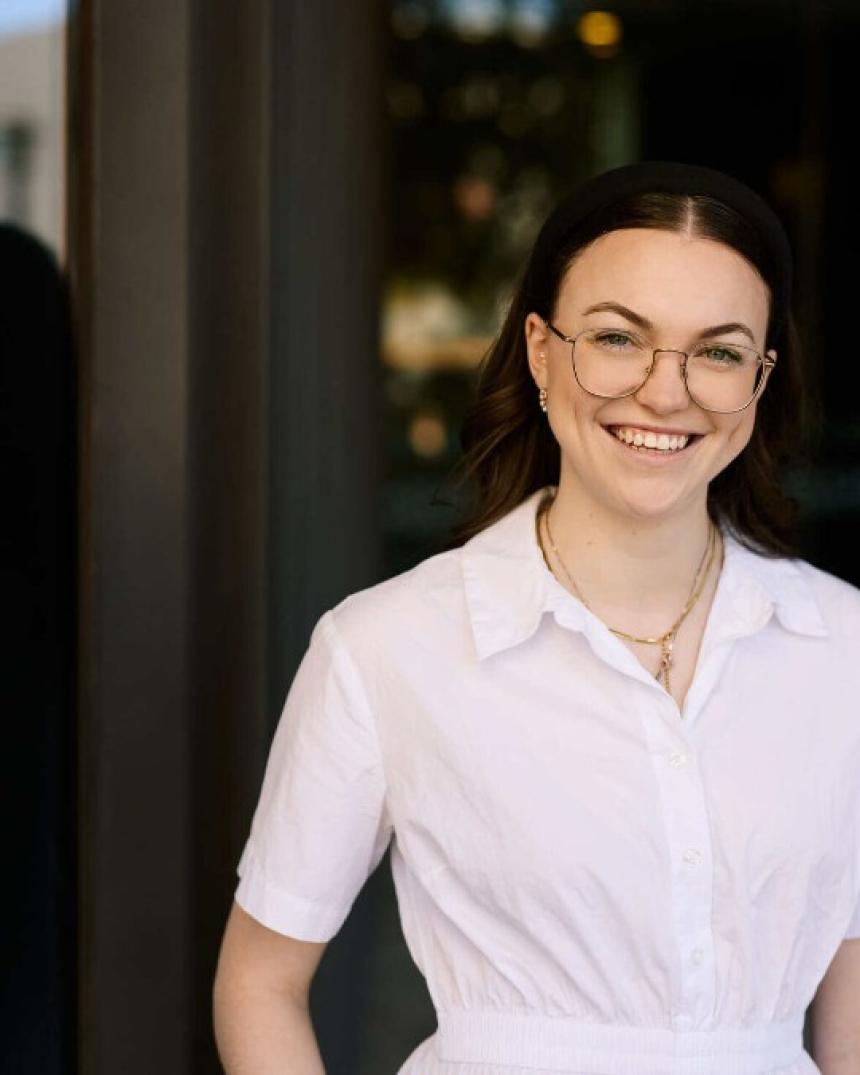
Dr Claire Hayward
Research Fellow
Future Industries Institute
Future Industries Institute
Eligible to supervise Masters and PhD as Co-Supervisor only - email supervisor to discuss availability.
My research sits at the intersection of environmental science, microbiology, and risk assessment, with a focus on antimicrobial resistance (AMR) as a One Health challenge — one that connects human, animal, and environmental systems rather than treating them in isolation. I'm particularly drawn to translational research: taking complex microbial and ecological processes and turning them into quantitative, decision-ready tools that government and industry can genuinely apply.
Methodologically, I combine Quantitative Microbial Risk Assessment (QMRA) with Bayesian Network modelling, which lets me integrate diverse and often incomplete evidence — genomic, epidemiological, environmental — into coherent, transparent models of risk. I bring a systems-thinking lens to this work, treating resistance as something that emerges from interconnected pressures across water, agricultural, and built environments, rather than from any single point of intervention.
I'm strongly industry- and government-engaged, working directly with regulators and utilities so that research outputs translate into applicable risk management and policy guidance rather than sitting in the literature. I also value interdisciplinary and international collaboration, and bring a practitioner's perspective to this work as a qualified Environmental Health Officer, alongside my academic research training.
My research sits at the intersection of environmental science, microbiology, and risk assessment, with a focus on antimicrobial resistance (AMR) as a One Health challenge — one that connects human, animal, and environmental systems rather than treating them in isolation. I'm particularly drawn to translational research: taking complex microbial and ecological processes and turning them into quantitative, decision-ready tools that government and industry can genuinely apply.
Methodologically, I combine Quantitative Microbial Risk Assessment (QMRA) with Bayesian Network modelling, which lets me integrate diverse and often incomplete evidence - genomic, epidemiological, environmental - into coherent, transparent models of risk. I bring a systems-thinking lens to this work, treating resistance as something that emerges from interconnected pressures across water, agricultural, and built environments, rather than from any single point of intervention.
I'm strongly industry- and government-engaged, working directly with regulators and utilities so that research outputs translate into applicable risk management and policy guidance rather than sitting in the literature. I also value interdisciplinary and international collaboration, and bring a practitioner's perspective to this work as a qualified Environmental Health Officer, alongside my academic research training.
| Date | Position | Institution name |
|---|---|---|
| 2025 - ongoing | Postdoctoral Research Fellow | University of South Australia |
| 2023 - 2024 | Associate Lecturer | Flinders University |
| Date | Institution name | Country | Title |
|---|---|---|---|
| 2021 - 2024 | Flinders University | Australia | PhD |
| 2020 - 2021 | Flinders University | Australia | Graduate Diploma |
| Aug 2026 | Adelaide University–Cornell One Health Strategic Alliance Collaborative Mobility Program grant (PI) $12,000 |
| Jul 2026 | Environment Institute Research Funding Scheme (CI) $14,000 |
| Mar 2026 | Vice-Chancellor’s Award for Doctoral Thesis Excellence |
|
Dec 2025 Jul 2025 Jul 2023 Jul 2023 Dec 2022 Jul 2022 2020 2020 |
Future Industries Institute Director’s Early Career Researcher Award SAAFE CRC Kick Start Grant – Chemical Monitoring Tools (CI) $40,000 FEMS International Congress Attendance Grant $500 College of Science & Engineering Travel Grant + HDR Conference Scheme $4,200 Flinders University EEE HDR Best Student Talk (Academic Choice) Australian Society for Microbiology Nancy Millis Student Award Flinders University BRIC Honours Scholarship $1,500 University Medal – outstanding academic achievement |
| Date | Role | Research Topic | Program | Degree Type | Student Load | Student Name |
|---|---|---|---|---|---|---|
| 2026 | Co-Supervisor | Fate of antimicrobial resistance (AMR) genes and their microbial hosts through wastewater reuse systems. | Doctor of Philosophy | Doctorate | Full Time | Miss Nazia Nawar Chowdhury |
| Date | Role | Committee | Institution | Country |
|---|---|---|---|---|
| 2022 - ongoing | Member | Australian Water Association SA Young Water Professionals | University of South Australia | Australia |
Connect With Me

External Profiles
