

Research Interests
Neuroscience, Behaviour and Brain HealthAPrf Steven Wiederman
Associate Professor
School of Pharmacy and Biomedical Sciences
College of Health
Eligible to supervise Masters and PhD - email supervisor to discuss availability.
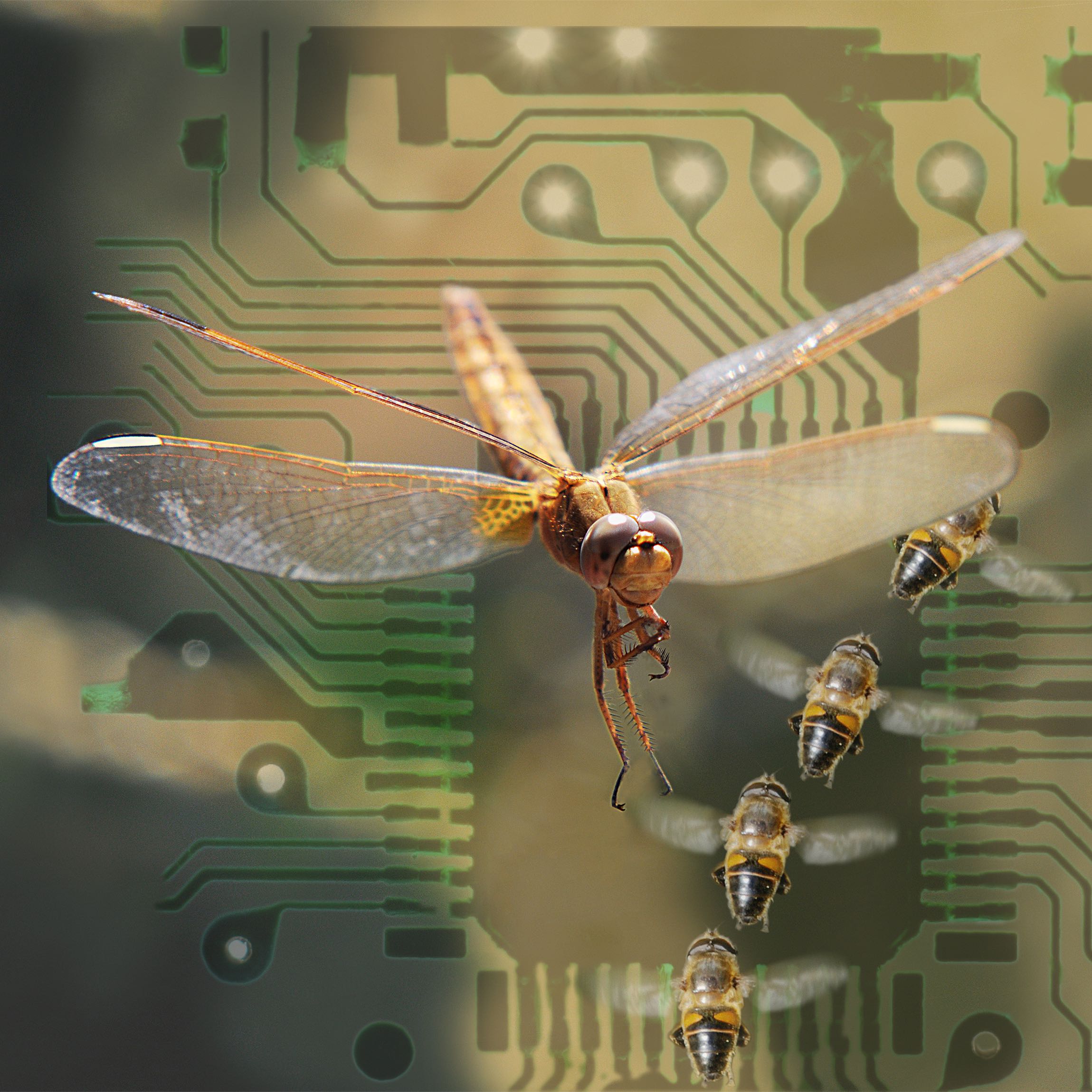
A/Prof Steven Wiederman is Academic Lead Research for the School of Pharmacy and Biomedical Science, Adelaide University. He heads the Visual Physiology & Neurobotics Laboratory and is presently a member of the ARC College of Experts. A/Prof Wiederman’s interdisciplinary laboratory uses flying insects as a tractable animal model, investigating visual processing from behavioural, physiological, anatomical and computational perspectives. He has held an ARC DECRA and Future Fellowship and presently holds two Discovery projects. He has been an investigator on industry-government research contracts crossing fields of neurophysiology, autonomous systems and human factors.In the Visual Physiology and Neurobotics Laboratory (VPNL), we study how the brain processes visual information. Consider a human catching a ball, a dog leaping at a Frisbee or a dragonfly hunting prey amidst a swarm. Brains large and small evolved the ability to predictively, focus attention on a moving target, whilst ignoring distracters and background clutter. We use electrophysiological techniques to investigate how flying insects see the world and build autonomous robots that emulate these neuronal principles.
(1) Capture behavioral data with arrays of medium-speed video cameras.
(2) Use intracellular, recording techniques to characterize neuronal physiology.
(3) Use dye-filling to examine underlying neuronal architecture.
(4) Develop computational models that mimic complex biological behavior.
(5) Design autonomous robots based on bio-inspired sensory and control processes.
Insects have evolved a relatively simple and efficient solution to a task that challenges the most sophisticated robotic vision systems – the detection, selection and pursuit of moving features in cluttered environments.
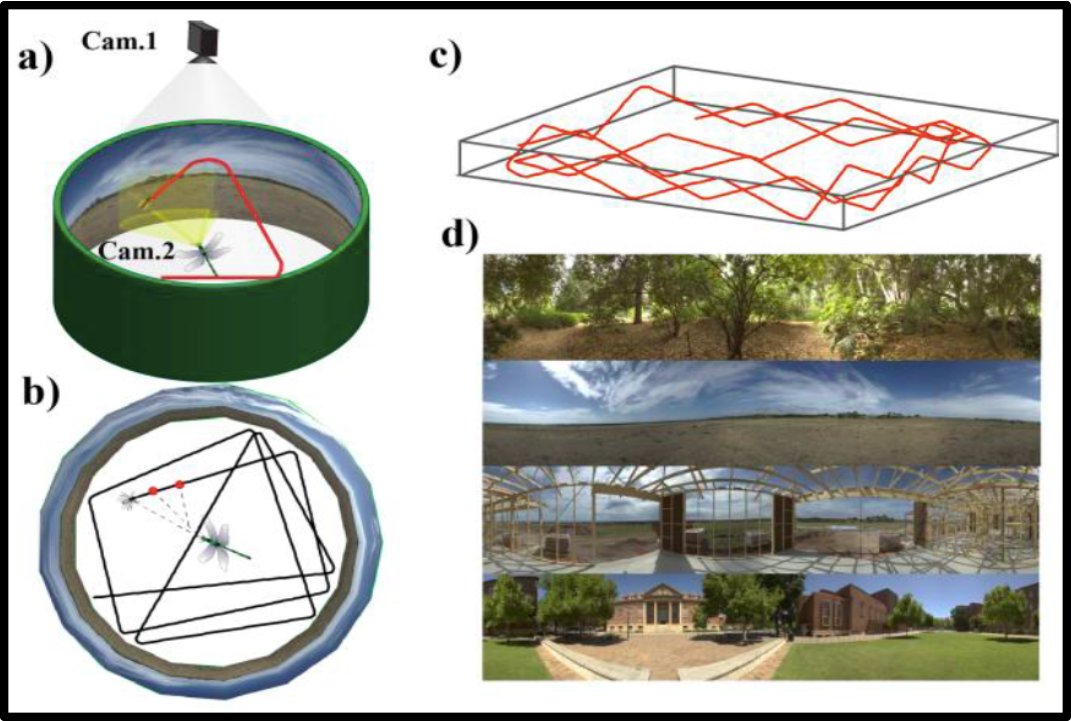 Research Project: Target-detecting neurons in the dragonfly. We study a set of neurons from the brain of insects that achieve this visual target-detection task in spectacular fashion. Our most recent work suggests that the insects use sophisticated mechanisms of attention similar to those in primates, to aid in the selection of one feature even in the presence of distracters (e.g. feeding in a swarm).
How do dragonfly target-detecting neurons discriminate moving targets amidst visual clutter whilst in closed-loop pursuit?
How do neuronal responses enable ‘prediction coding’ (estimating target trajectories) and ‘selective attention’ (selecting one target amidst distracters)? In this project, we are applying pharmacological agents and conducting immunohistochemistry to investigate the cellular mechanisms that underlie these properties observed in target-detecting neurons. This project is suitable for Masters and PhD students, however we also have contributing projects for 3rd year and Honours students, for example, examining the effect of individual pharmacological agents on earlier visual processing pathways.
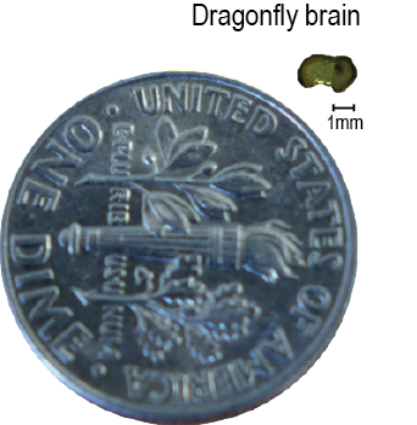 Research Project: Optic-flow neurons in the dragonfly. We recently discovered a set of neurons in the dragonfly optic lobes that respond to wide-field motion stimuli. Unlike their fly counterparts, these dragonfly visual neurons use adaptive processes to allow them to encode different velocity ranges. This likely underlies their ability to hover near stationary, yet pursue prey at speeds over 60 km/hr. In this project, we will use electrophysiological techniques to record from optic flow neurons and discover how they are able to respond to diverse visual stimuli in such a remarkable manner. This project is suitable for Masters and PhD students.
Research Project: Computational Modeling. Combining electrophysiological experiments with computational modeling permits us to address important question in neuroscience. We have projects modeling target and optic-flow neurons more suited to students with a computational background. Students can tailor their projects to include both wet and dry neurosciences. We have variants of these projects that are suitable for Honours, Masters and PhD students. We also host Engineering students in our laboratory to conduct projects in this field of research.
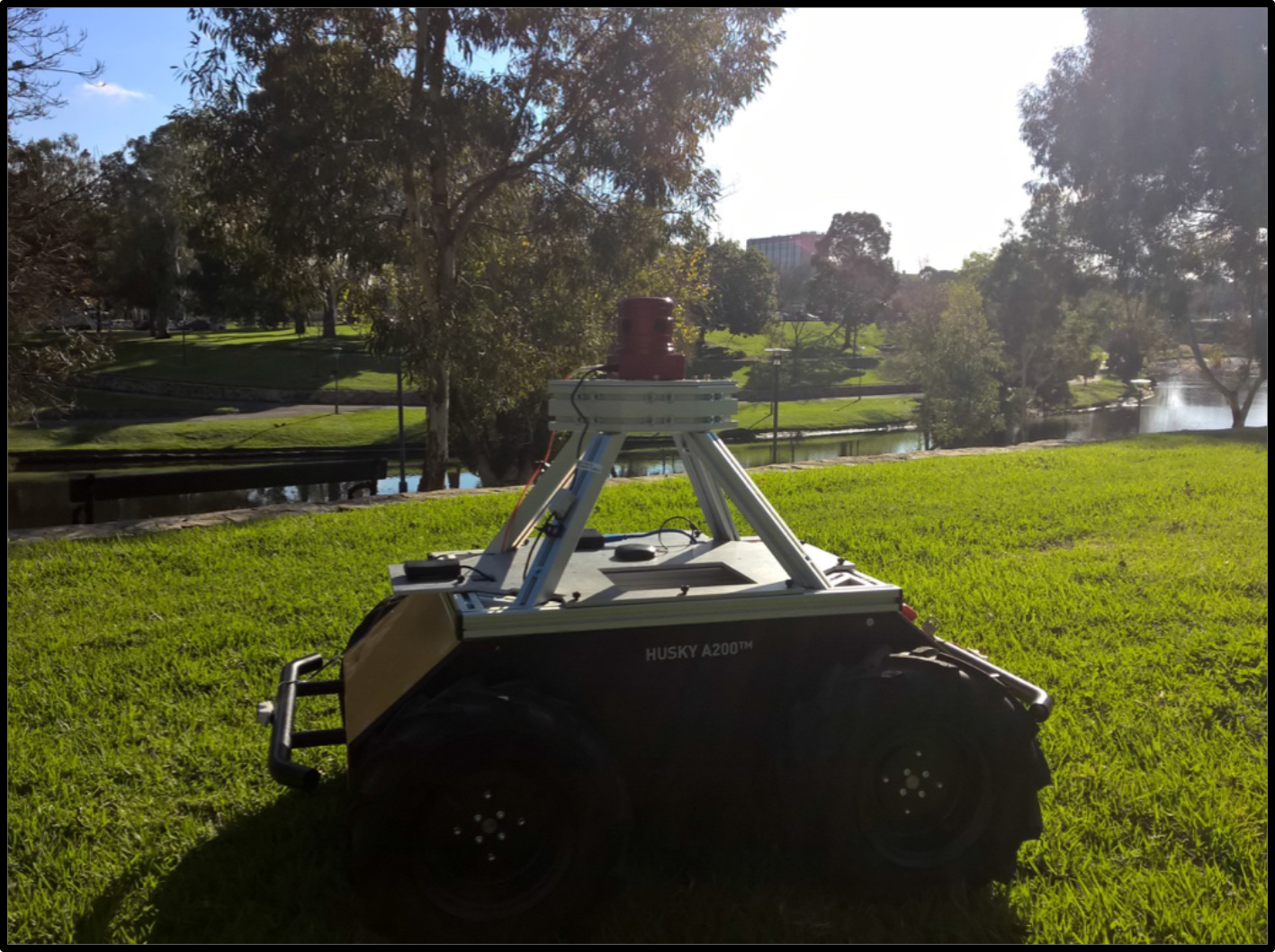 Research Project: Neurobotics: The physiological data obtained in our laboratory feeds into our robotics projects, as we implement neuronal processing onto an autonomous platform. This research involves computational modelling and hardware development, and is therefore suited to those with mathematical or engineering backgrounds. We work with collaborators in both Mechanical Engineering, Electrical Engineering and Computer Sciences on jointly supervised projects.
Research Project: Neuro-inspired Deep Learning: In collaboration with Computer Sciences, we are working on developing novel deep learning networks, suitable for the task of visual feature discrimination. These Defence funded projects for Honours, Masters and PhD students have special requirements, such as Australian Citizenship. Additional top-up scholarships may apply in some conditions.
Media Links:
The Advertiser (2017), SA universities join forces to win slice of defence dollars
Wall Street Journal (2015), Scientists Tap Dragonfly Vision to Build a Better Bionic Eye
Australian Financial Review (2017), University of Adelaide test dragonfly neuron for artificial vision system
SAE (2017), Dragonfly study yields insight into vehicle autonomy
United Press International (2017), Dragonflies can predict their prey's next move
United Press International (2017), Honey bees have sharper eyesight than we thought
The Engineer (2017), Dragonfly inspires predictive vision for driverless cars
Daily Mail (2017), Dragonfly's brains can predict the movement of their prey
Gizmodo (2017), How the Dragonfly's Surprisingly Complex Brain Makes it a Deadly Hunter
Popular Science (2013), How Dragonflies Could Help Scientists Build Better Robots
New York Times (2013), Nature’s Drone, Pretty and Deadly
NBC News (2012), Dragonfly has human-like power of concentration
Science Daily (2012), Dragonflies have human-like 'selective attention
Science Daily (2013), Dragonflies can see by switching 'on' and 'off'
Science Daily (2015), Robot eyes will benefit from insect vision
Science Daily (2017), Dragonfly brains predict the path of their prey
Science Daily (2017), Honey bees have sharper eyesight than we thought
The Conversation (2012), Enter the dragonfly: insect shows human-like visual attention
| Date | Position | Institution name |
|---|---|---|
| 2020 - ongoing | Associate Professor | University of Adelaide |
| 2016 - 2019 | Senior Lecturer | University of Adelaide |
| 2014 - 2015 | Lecturer | University of Adelaide |
| 2013 - 2014 | ARC Senior Research Associate | University of Adelaide |
| 2011 - 2012 | Postdoctoral Researcher | University of Adelaide |
| 2009 - 2011 | Associate Lecturer | University of Adelaide |
| Date | Institution name | Country | Title |
|---|---|---|---|
| 2006 - 2007 | University of Adelaide | Australia | Graduate Certificate In Education (Higher Ed) |
| 2005 | University of Technology, Sydney | Australia | Bachelor of Engineering (Comp Sys) 1st Class Hons |
| 2005 | University of Technology, Sydney | Australia | Bachelor of Medical Sciences |
| 2005 - 2008 | University of Adelaide | Australia | PhD |
| Year | Citation |
|---|---|
| 2023 | Evans, B., Wiederman, S., & Lancer, B. (2023). Inhibitory Networks Explain Selective Attention in Dragonfly Target Detecting Neurons. Poster session presented at the meeting of JOURNAL OF COMPUTATIONAL NEUROSCIENCE. SPRINGER. |
| 2022 | Millar, S., O'Rielly, J., McConnochie, G., Blencowe, M., Turner, L., Wiederman, S., . . . Thewlis, D. (2022). Moving from the lab to the field: accuracy and reliability of wearable sensors in the estimation of lower limb joint kinematics. Poster session presented at the meeting of Defence Human Sciences Symposium. |
| 2022 | O'Rielly, J., Millar, S., Blencowe, M., Turner, L., Wiederman, S., Palmer, E., . . . Ma-Wyatt, A. (2022). Visual perceptual performance during locomotion: implications for information display technologies. Poster session presented at the meeting of Defence Human Sciences Symposium. |
| 2019 | Han, M. (2019). Intracellular delivery of nanoparticles via microelectrophoresis technique. Poster session presented at the meeting of Proceedings Volume 10893, Reporters, Markers, Dyes, Nanoparticles, and Molecular Probes for Biomedical Applications XI; 108930C (2019) https://doi.org/10.1117/12.2507707. San Francisco, California, United States. |
| 2013 | James, D., Steven, W., & David, O. (2013). Mapping predictive facilitation in a dragonfly target neuron. Poster session presented at the meeting of Frontiers in Physiology. Frontiers Media SA. DOI |
| 2010 | Horton, D., Wiederman, S., & Saint, D. (2010). Lecture attendance, learning style and assessment outcome in physiology students. Poster session presented at the meeting of The Education Research Group of Adelaid. Adelaide, Australia: The University of Adelaide. |
| - | David, O., & Steven, W. (n.d.). Contrast sensitivity and spatial inhibition in insect small target motion detectors. Poster session presented at the meeting of Frontiers in Physiology. Frontiers Media SA. DOI |
| - | Steven, W., James, D., & David, O. (n.d.). Selective attention in the dragonfly. Poster session presented at the meeting of Frontiers in Physiology. Frontiers Media SA. DOI |
| - | Liliana, C., Steven, W., & David, O. (n.d.). Retinal movements in the blowfly Calliphora Stygia. Poster session presented at the meeting of Frontiers in Physiology. Frontiers Media SA. DOI |
| Year | Citation |
|---|---|
| 2013 | O'Carroll, D. C., Wiederman, S. D., & Shoemaker, P. A. (2013). Mechanism for Visual Detection of Small Targets in Insects. Defense Technical Information Center. DOI |
| Year | Citation |
|---|---|
| 2009 | Wiederman, S. (2009). A neurobiological and computational analysis of target discrimination in visual clutter by the insect visual system. (PhD Thesis, The University of Adelaide). |
| - | Wiederman, S. (n.d.). Wiederman SD, PhD Thesis. DOI |
| Year | Citation |
|---|---|
| - | James, J., Wiederman, S., Cazzolato, B., & Grainger, S. (n.d.). ACRA_files_2018_and_2019.zip [Computer Software]. DOI |
| - | Hussaini, M., Evans, B., & Wiederman, S. (n.d.). Data analysis scripts for 'Higher temperatures improve visual sensitivity and broadens tuning to faster velocities in dragonfly target-detecting neurons' [Computer Software]. DOI |
| Year | Citation |
|---|---|
| 2022 | Fabian, J., O’Carroll, D., & Wiederman, S. (2022). Sparse spike trains and the limitations of rate codes underlying rapid behaviour. DOI |
| 2021 | Bekkouche, B., Shoemaker, P., Fabian, J., Rigosi, E., Wiederman, S., & O’Carroll, D. (2021). Modelling nonlinear dendritic processing of facilitation in a dragonfly target-tracking neuron. DOI |
| 2020 | Fabian, J., el Jundi, B., Wiederman, S., & O’Carroll, D. (2020). The complex optic lobe of dragonflies. DOI Europe PMC4 |
| 2020 | Evans, B. J. E., Fabian, J. M., O’Carroll, D. C., & Wiederman, S. D. (2020). Dragonfly visual neurons selectively attend to features in naturalistic scenes. DOI Europe PMC1 |
| 2020 | Han, M., Zhao, J., Fabian, J. M., Mustafa, S., Ruan, Y., Wiederman, S., & Ebendorff-Heidepriem, H. (2020). Intracellular Delivery of Nanoparticles <i>via</i> Microelectrophoresis Technique: Feasibility demonstration. DOI |
Australian Research Council Discovery Project - Dim Light Vision in Dragonflies, 2024-2027
Australian Research Council Discovery Project - Flapping wing robotics, 2024 - 2027
Defence Trailblazer Bio-Inspired Counter-Uncrewed Aerial Systems (CUAS), 2024-2025
Australian Research Council Future Fellowship, 2018-2022
Next Generation Technologies Fund, Counter Improvised Threats Grand Challenge, 2018-2020
Australian Research Council Discovery Early Career Researcher Award, 2015-2017
Course Coordinator and Lecturer in the 3rd Year Course, Cellular & System Neurobiology
Lecturer in Human Physiology IIA and Dentistry
| Date | Role | Research Topic | Program | Degree Type | Student Load | Student Name |
|---|---|---|---|---|---|---|
| 2022 | Co-Supervisor | The Effect of Information Displays and Associated Latencies on Aspects of Human Performance Including Cognition, Perception, and Locomotion Biomechanics | Doctor of Philosophy | Doctorate | Part Time | Miss Lucy Jane Turner |
| 2022 | Principal Supervisor | The Effect of Temperature on the Electrophysiological Properties of Dragonfly Small Target Motion Detecting Neurons | Doctor of Philosophy | Doctorate | Part Time | Mr Mahdi Hussaini |
| 2022 | Principal Supervisor | The Effect of Temperature on the Electrophysiological Properties of Dragonfly Small Target Motion Detecting Neurons | - | Doctorate | Part Time | Mr Mahdi Hussaini |
| 2022 | Co-Supervisor | The Effect of Information Displays and Associated Latencies on Aspects of Human Performance Including Cognition, Perception, and Locomotion Biomechanics | Doctor of Philosophy | Doctorate | Part Time | Miss Lucy Jane Turner |
| 2022 | Principal Supervisor | The Effect of Temperature on the Electrophysiological Properties of Dragonfly Small Target Motion Detecting Neurons | Doctor of Philosophy | Doctorate | Part Time | Mr Mahdi Hussaini |
| 2021 | Co-Supervisor | How do we use visual information while walking? Implications for the use of virtual and augmented reality devices for training and deployment. |
Doctor of Philosophy | Doctorate | Part Time | Mr Marlon Blencowe |
| 2021 | Principal Supervisor | An anatomical and physiological investigation of odonate vision. | Doctor of Philosophy | Doctorate | Part Time | Miss Katie Marie Skeen |
| 2021 | Co-Supervisor | How do we use visual information while walking? Implications for the use of virtual and augmented reality devices for training and deployment. |
Doctor of Philosophy | Doctorate | Part Time | Mr Marlon Blencowe |
| 2019 | Principal Supervisor | The neurophysiology of dragonfly optic flow encoding with applications to neurobotic engineering | Doctor of Philosophy | Doctorate | Part Time | Mr Edward Luong |
| 2019 | Principal Supervisor | The neurophysiology of dragonfly optic flow encoding with applications to neurobotic engineering | - | Doctorate | Part Time | Mr Edward Luong |
| 2019 | Principal Supervisor | The neurophysiology of dragonfly optic flow encoding with applications to neurobotic engineering | Doctor of Philosophy | Doctorate | Part Time | Mr Edward Luong |
| Date | Role | Research Topic | Program | Degree Type | Student Load | Student Name |
|---|---|---|---|---|---|---|
| 2019 - 2023 | Co-Supervisor | Lightweight and Motion Guided Neural Network Algorithms for Onboard Drone Detection and Flight | Doctor of Philosophy | Doctorate | Full Time | Mr Hamish Christopher Pratt |
| 2018 - 2022 | Co-Supervisor | Intracellular delivery and voltage sensitivity of nanomaterials for the optical imaging of neuronal activity | Doctor of Philosophy | Doctorate | Full Time | Ms Mengke Han |
| 2018 - 2024 | Principal Supervisor | Adaptation in Dragonfly Target-Detecting Neurons | Doctor of Philosophy | Doctorate | Part Time | Mr Matthew Benjamin Schwarz |
| 2017 - 2022 | Principal Supervisor | An Electrophysiological Investigation into Selective Attention in the Dragonfly | Doctor of Philosophy | Doctorate | Part Time | Mr Benjamin Horatio Lancer |
| 2016 - 2023 | Principal Supervisor | A Computational Investigation of Target Detection and Tracking by Insect Small Target Motion Detector Neurons | Doctor of Philosophy | Doctorate | Part Time | John Vincent James |
| 2015 - 2019 | Principal Supervisor | Neuronal Encoding of Natural Imagery in Dragonfly Motion Pathways | Doctor of Philosophy | Doctorate | Full Time | Bernard Evans |
| 2015 - 2017 | Co-Supervisor | Microelectrophoresis of Semiconductive Quantum Dots | Master of Philosophy | Master | Full Time | Ms Mengke Han |
| 2014 - 2017 | Principal Supervisor | A Neurobiological Investigation of Visual Target Detection and the Optic Lobe of Dragonflies | Doctor of Philosophy | Doctorate | Full Time | Mr Joseph Fabian |
| 2013 - 2017 | Co-Supervisor | An Insect-Inspired Target Tracking Mechanism for Autonomous Vehicles | Doctor of Philosophy | Doctorate | Full Time | Miss Zahra Bagheri |
| 2010 - 2014 | Co-Supervisor | Facilitation in Dragonfly Target Motion Detecting Neurons | Doctor of Philosophy | Doctorate | Full Time | Mr James Robert Dunbier |
Connect With Me

External Profiles


