
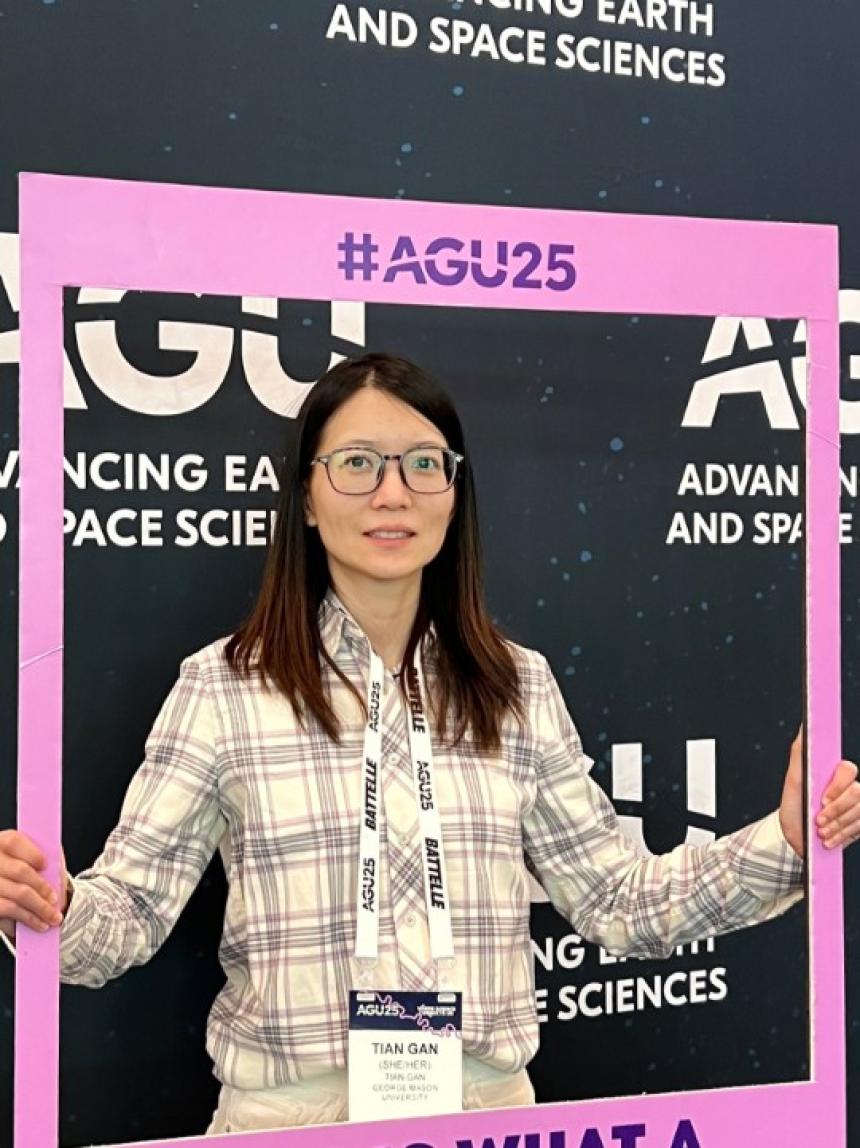
Dr Tian Gan
ARC Grant-Funded Researcher B
School of Physics, Chemistry and Earth Sciences
College of Science
I am a geochemist and geobiologist interested in understanding how interactions among the solid Earth, surface environments, and the biosphere have shaped our planet through deep time. My research combines isotope and elemental geochemistry with sedimentology, stratigraphy, and palaeontology to reconstruct changes in continental weathering, ocean chemistry, redox conditions, and global biogeochemical cycles.
I joined TES as a three-year postdoctoral researcher at Adelaide University in 2026, where my current research focuses on the Palaeo–Mesoproterozoic geology and geochemistry of the Bangemall Supergroup in Western Australia and broadly coeval sedimentary successions in India. I aim to use integrated geological and geochemical approaches to better understand how tectonics, continental weathering, ocean chemistry, nutrient cycling, and marine redox conditions evolved during this important interval of Earth history.
Before joining Adelaide University, I conducted postdoctoral research at the University of Maryland and George Mason University in the United States. Much of my previous research has focused on major environmental and biological transitions during the Neoproterozoic and early Phanerozoic. I use multiple isotope systems, particularly Li, U, Sr, Tl, and Cd isotopes, together with conventional stable isotopes and trace-element geochemistry, to investigate the connections among continental weathering, ocean oxygenation, carbon cycling, climate change, and biological innovation.
My previous work has explored Earth-system changes associated with the Cryogenian Snowball Earth and its aftermath, the Ediacaran Shuram Excursion, and the Ediacaran–Cambrian transition. I am particularly interested in how continental weathering and ocean redox evolved across these major transitions and how these environmental changes may have influenced the emergence and diversification of complex life.
More broadly, my research seeks to connect geological observations with geochemical records across different spatial and temporal scales. At Adelaide University, I am excited to extend this approach further back into the Palaeo–Mesoproterozoic and explore how long-term changes in tectonics, weathering, ocean chemistry, and nutrient availability contributed to the evolution of the Earth system and ultimately set the stage for later biological innovation.
My research focuses on understanding how Earth’s surface environments, oceans, and climate have co-evolved through geological time, with particular emphasis on major environmental and biological transitions in the Precambrian and early Phanerozoic. I use isotope geochemistry, including lithium (Li), uranium (U), thallium (Tl), strontium (Sr), carbon (C), and oxygen (O) isotopes, together with sedimentological and geochemical records preserved in ancient sedimentary rocks to reconstruct changes in continental weathering, seawater chemistry, ocean redox conditions, and global biogeochemical cycles. My current research explores the evolution of Proterozoic oceans and environments, including the Mesoproterozoic Earth system, Neoproterozoic glaciations and oxygenation, and major carbon-cycle perturbations such as the Ediacaran Shuram Excursion. A central goal of my work is to develop and apply novel isotope proxies and quantitative geochemical approaches to better understand the interactions among tectonics, climate, ocean chemistry, and the evolution of life on Earth.
| Date | Position | Institution name |
|---|---|---|
| 2022 - 2026 | Postdoctoral Fellow | University of Maryland & George Mason University |
| 2021 - 2022 | Postdoctoral Fellow | Virginia Tech |
| Language | Competency |
|---|---|
| Chinese (Mandarin) | Can read, write, speak, understand spoken and peer review |
| English | Can read, write, speak, understand spoken and peer review |
| Date | Institution name | Country | Title |
|---|---|---|---|
| 2017 - 2022 | University of Chinese Academy of Sciences & Virginia Tech | China & USA | Ph.D. |
| 2014 - 2017 | University of Chinese Academy of Sciences | China | M.Sc. |
| Year | Citation |
|---|---|
| 2026 | Gan, T., Gilleaudeau, G. J., Pedersen, M. G., Doerrler, A. D., Maksimenko, V., Grazhdankin, D. V., . . . Kaufman, A. J. (2026). Continental weathering as a driver of the Ediacaran Shuram Excursion. Communications Earth & Environment, 1-30. |
| 2026 | Caxito, F. A., Lana, C., Carvalho, D., Uhlein, G. J., Reis, C., Dias, P. H. A., . . . Leite, M. M. (2026). Coda of the snowball: combined U-Pb LA-ICPMS dating of calcite-after-aragonite crystal fans and clumped isotope thermometry of Ediacaran cap carbonates. Geoscience Frontiers, 17(2), 102218. Scopus2 |
| 2026 | Qu, H., Pang, K., Gan, T., Loron, C. C., Ouyang, Q., Cui, W., . . . Xiao, S. (2026). Fungal–algal associations from the early Ediacaran herald increasing symbiotic complexity before modern lichens. Proceedings of the Royal Society B Biological Sciences, 293(2075), 20260673. |
| 2026 | Zhou, G., Gan, T., Zhou, M., & Luo, T. (2026). Glacial Isostatic Adjustment–Driven Hydrothermal Activity Recorded by Sheet-Crack Cements in Marinoan Cap Dolostones, South China: Fluid-Inclusion Constraints. ACS Earth and Space Chemistry, 10(3), 633-649. |
| 2024 | Remírez, M. N., Gilleaudeau, G. J., Gan, T., Kipp, M. A., Tissot, F. L. H., Kaufman, A. J., & Parente, M. (2024). Carbonate uranium isotopes record global expansion of marine anoxia during the Toarcian Oceanic Anoxic Event. Proceedings of the National Academy of Sciences of the United States of America, 121(27), e2406032121. Scopus23 Europe PMC2 |
| 2024 | Gan, T., Tian, M., Wang, X. K., Wang, S., Liu, X. M., Jiang, G., . . . Xiao, S. (2024). Lithium isotope evidence for a plumeworld ocean in the aftermath of the Marinoan snowball Earth. Proceedings of the National Academy of Sciences of the United States of America, 121(46), e2407419121. Scopus7 Europe PMC1 |
| 2023 | Chen, Y., Gan, T., Guan, S., Zhao, J., Kong, Z., & Deng, M. (2023). Shuitoushan magmatic hydrothermal lead-zinc deposit in western Yunnan: Evidence from REE and C-O isotopes. Geology in China, 50(3), 818-836. Scopus1 |
| 2022 | Gan, T., Zhou, G., Luo, T., Pang, K., Zhou, M., Luo, W., . . . Xiao, S. (2022). Earliest Ediacaran speleothems and their implications for terrestrial life after the Marinoan snowball Earth. Precambrian Research, 376, 106685. Scopus11 |
| 2021 | Gan, T., Luo, T., Pang, K., Zhou, C., Zhou, G., Wan, B., . . . Xiao, S. (2021). Cryptic terrestrial fungus-like fossils of the early Ediacaran Period. Nature Communications, 12(1), 641. Scopus72 Europe PMC14 |
| 2021 | Zhang, Y., Luo, T., Gan, T., Zhou, M., & Han, X. (2021). Early Silurian Wuchuan–Sihui–Shaoguan exhalative sedimentary pyrite belt, South China: constraints from zircon dating for K-bentonite of the giant Dajiangping deposit. Acta Geochimica, 40(1), 1-12. Scopus3 |
| 2018 | Zhou, M., Luo, T., Huff, W. D., Yang, Z., Zhou, G., Gan, T., . . . Zhang, D. (2018). Timing the termination of the Doushantuo negative carbon isotope excursion: evidence from U-Pb ages from the Dengying and Liuchapo formations, South China. Science Bulletin, 63(21), 1431-1438. Scopus32 |
| 2017 | Zhou, G., Luo, T., Zhou, M., Xing, L., & Gan, T. (2017). A ubiquitous hydrothermal episode recorded in the sheet-crack cements of a Marinoan cap dolostone of South China: Implication for the origin of the extremely 13C-depleted calcite cement. Journal of Asian Earth Sciences, 134, 63-71. Scopus17 |
| Year | Citation |
|---|---|
| 2025 | Gan, T., Doerrler, A., Gilleaudeau, G., & Kaufman, A. (2025). Lithium Isotope Techniques for Brine-Based Critical Mineral Exploration. In Geological Society of America Abstracts with Programs. Geological Society of America. DOI |
| 2025 | Gan, T., Doerrler, A., Gilleaudeau, G., Bykova, N., Marusin, V., Kochnev, B., . . . Kaufman, A. (2025). Lithium isotope constraints on terrestrial clay formation during the Ediacaran–Cambrian transition. In Geological Society of America Abstracts with Programs. Geological Society of America. DOI |
| 2025 | Kaufman, A., Gan, T., Pedersen, M., Doerrler, A., Maksimenko, V., Grazhdankin, D., . . . Hellmann, J. (2025). Intense global continental weathering drove the Ediacaran Shuram Excursion. In Goldschmidt2025 abstracts. European Association of Geochemistry. DOI |
| 2024 | Gan, T., Gilleaudeau, G. J., Gilleaudeau, G. J., Gilleaudeau, G. J., Pedersen, M., Pedersen, M., . . . Kaufman, A. J. (2024). INTENSE CONTINENTAL CHEMICAL WEATHERING DURING THE EDIACARAN SHURAM EXCURSION. In Geological Society of America Abstracts with Programs. Geological Society of America. DOI |
| 2023 | Gan, T., Gilleaudeau, G., Gilleaudeau, G., Gilleaudeau, G., Grazhdankin, D., Grazhdankin, D., . . . Kaufman, A. (2023). RECONSTRUCTING THE LI ISOTOPIC COMPOSITION OF TERMINAL EDIACARAN SEAWATER. In Geological Society of America Abstracts with Programs. Geological Society of America. DOI |
| 2022 | Gan, T., Tian, M., Wang, X. -K., Wang, S., Liu, X., Luo, T., & Xiao, S. (2022). Lithium isotope evidence for a plumeworld ocean in the aftermath of a Cryogenian Snowball Earth. In Goldschmidt2022 abstracts. European Association of Geochemistry. DOI |
| 2020 | Gan, T., Zhou, G., Zhou, G., Zhou, G., Zhou, G., Luo, T., . . . Xiao, S. (2020). PALEO-SPELEOTHEMS AS EVIDENCE FOR WIDESPREAD KARSTIFICATION IN THE AFTERMATH OF THE MARINOAN DEGLACIATION (635 MA) IN SOUTH CHINA. In Geological Society of America Abstracts with Programs. Geological Society of America. DOI |
Connect With Me


External Profiles


