
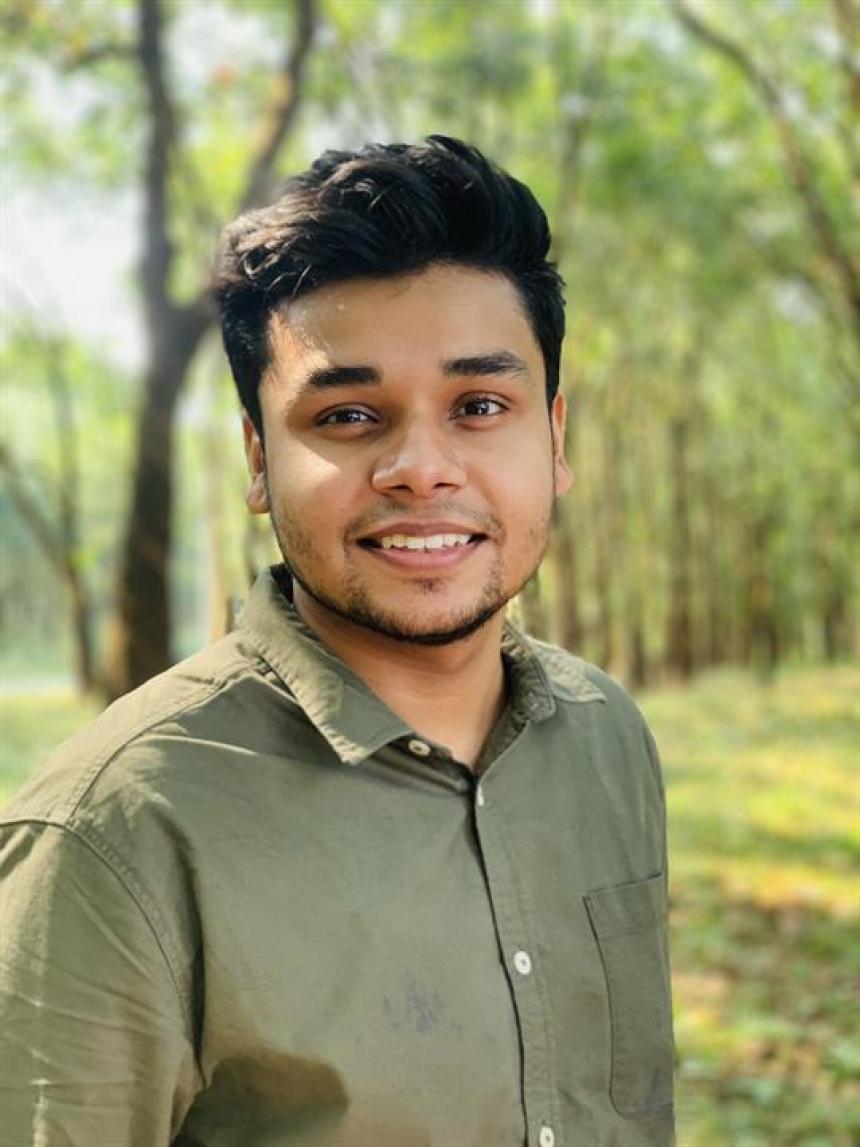
Mr Shah Islam
Higher Degree by Research Candidate
School of Electrical and Mechanical Engineering
College of Engineering and Information Technology
Currently, I'm pursuing Ph.D. under school of EEE, my research topic is designing energy infrastructure for EV charging and meeting the other energy demands at mining industries. Previously, I was appointed as GRS at Monash, where I did my master's degree by research on designing solar PV system for charging electric buses and assessing the techno-economic feasibility of integrating solar PV system with the grid. Earlier on, I did my bachelor's degree in Electrical Engineering from Multimedia University, Malaysia.
-
PhD: Optimal energy infrastructure and storage system design for an electrified mine with battery-supported electric vehicles (BEVs) and associated machinery
Transitioning towards renewable energies from traditional fossil fuels for heavy industries is one of the most important strategies to mitigate their impact on climate change. In the mining industry, the carbon footprint depends on ore extraction and movement to onsite processing facilities, which demands a high amount of energy, water and use of diesel. Hence, the mining industry is moving towards electrification in line with the global trend for decarbonization. In this vein, an optimized microgrid energy infrastructure consisting of renewable and non-renewable power sources is crucial to provide an uninterrupted power supply and meet the energy demand in an electrified mine with battery-supported electric vehicles (BEVs) and associated electric machinery. In this regard, my doctoral research aims to develop a systematic and general algorithm for optimal microgrid technology selection and sizing based on rigorous techno-economic and carbon emission models and trade-off analyses between cost, reliability, and emission in the mining industry.
-
MPhil: Techno-economic feasibility assessment of using solar energy for Bus Rapid Transit (BRT) Sunway transport system
Solar Photovoltaics (PV) have become one of the significant renewable energy sources to produce sustainable and clean energy. In recent years, there has been an increasing interest to utilize solar energy for residential and commercial applications. Comparatively, little has been used in transport sector. Until date, transport sector heavily depends on the fossil fuels and this has caused high carbon emissions thus damaging the environment. To bring sustainable development in transport sector, Electric Vehicles (EV) were introduced as is the case of Bus Rapid Transit (BRT) electric buses on BRT-Sunway Line. However, these EVs are charged using conventional grid which are mostly depended on fossil fuels power plants. My MPhil research therefore developed a model to investigate the techno-economic feasibility of solar energy for an electric bus depot. The influence of the bus charging routine (BCR) on the techno-economic performance of solar PV systems was also investigated.
-
BEng: Improved design of power capacitor and sustainability in harsh condition
Power capacitor is considered as a useful component for the transmission line. It is used in order to reduce the inductivity. If the inductivity is high in the transmission line larger quantities of current will be flown through. That is why the consumer’s electricity bill will be much higher. In order to solve this problem power capacitor has been installed. Power capacitor reduces the inductivity in the transmission line and improves the power factor. Electricity bill will be reduced for the consumers if power capacitor has been improved. However, quality power capacitor manufacturing has always been challenging as transmission line has very high voltage and power capacitor has to sustain that voltage level. If there is faulty condition and power capacitor is not sustainable enough in that harsh condition, it may explode and it will create severe harm to the humans and the environment. In my research, improved design of power capacitor has been elaborated with quality testing and also research has been done on possible reasons to explode and make the design more reliable so that it can sustain harsh condition.
| Date | Position | Institution name |
|---|---|---|
| 2026 - ongoing | Lecturer | Imperial Engineering Education |
| 2025 - 2025 | Visiting Researcher | Norwegian University of Science and Technology |
| 2024 - 2025 | Research Consultant (Intern) | ZaZzTech @ UTS Startups |
| 2023 - 2026 | P/T Tchg Lecturer | The University of Adelaide |
| 2022 - ongoing | Doctoral Researcher | The University of Adelaide |
| 2021 - 2022 | Lecturer | East Delta University |
| 2018 - 2020 | MPhil Researcher | Monash University |
| 2014 - 2015 | Buddy Tutor | Multimedia University |
| Language | Competency |
|---|---|
| Arabic | Can read and write |
| Bengali | Can read, write, speak, understand spoken and peer review |
| English | Can read, write, speak, understand spoken and peer review |
| German | Can read and write |
| Malay | Can read, write and speak |
| Date | Institution name | Country | Title |
|---|---|---|---|
| 2025 - 2025 | Norwegian University of Science and Technology | Norway | Doctoral External Research in Computer Science |
| 2022 - 2026 | University of Adelaide | Australia | Doctor of Philosophy (Ph.D.) in Engineering |
| 2018 - 2020 | Monash University | Australia | Master of Engineering Science (Research) |
| 2015 - 2016 | Hof University of Applied Sciences | Germany | Bachelor Exchange Program |
| 2013 - 2018 | Multimedia University | Malaysia | Bachelor of Engineering (Honours) Electrical |
| 2012 - 2013 | Multimedia University | Malaysia | Foundation in Engineering |
| Date | Title | Institution name | Country |
|---|---|---|---|
| 2023 | University Lecturer | VETASSESS | Australia |
| 2018 | Graduate Engineer | Board of Engineers Malaysia | Malaysia |
| Year | Citation |
|---|---|
| 2026 | Islam, S. M. M., Ranjbar, H., Pourmousavi, S. A., & Soong, W. L. (2026). An accurate and computationally efficient lithium-ion battery operation and degradation framework for planning and sizing studies in renewable energy systems. Journal of Energy Storage, 150, 120575. |
| 2026 | Sarker, I. A., Salman, M., Ullah, R., Islam, S. M. M., Saleheen, M. Z., Masdar, M. S., . . . Khalid, R. M. (2026). Techno-economic feasibility and optimal design of grid-connected PV system with energy storage: A case study for Malaysia's institutional. Chemical Engineering Research and Design, 227, 925-944. |
| 2025 | Ranjbar, H., Assimi, H., Islam, S. M. M., Pourmousavi, S. A., & Soong, W. L. (2025). Optimal planning of renewable-based mining microgrids: a comparative study of multi-objective evolutionary algorithms. Optimization Letters, 1-24. Scopus7 WoS6 |
| 2025 | Islam, S. M. M., Salema, A. A., Sarker, I. A., & Tanima, R. F. (2025). Design, Sizing and Economic Analysis of Grid-Connected Solar PV (GCPV) System for an Electric Bus Depot in Malaysia. International Journal of Renewable Energy Research, 15(4), 860-876. Scopus1 |
| 2024 | Assimi, H., Hashemian Ataabadi, S. N., Islam, S. M. M., Soong, W. L., & Pourmousavi, S. A. (2024). Toward Underground Mobile Fleet Electrification: Three essential steps to make a real change. IEEE Electrification Magazine, 12(1), 16-26. Scopus5 WoS5 |
| 2022 | Mominul Islam, S. M., Salema, A. A., Saleheen, M. Z., & Lim, J. M. Y. (2022). The influence of shifting the electric bus charging routine on the techno-economic performance of a solar-powered bus depot. Energy, 239, 18 pages. Scopus22 WoS17 |
| 2022 | Uddin, M. N., Hafi, M. F. B., Hossain, S., & Islam, S. M. M. (2022). Drug Sentiment Analysis using Machine Learning Classifiers. International Journal of Advanced Computer Science and Applications, 13(1), 92-100. Scopus26 WoS10 |
| 2021 | Saleheen, M. Z., Salema, A. A., Mominul Islam, S. M., Sarimuthu, C. R., & Hasan, M. Z. (2021). A target-oriented performance assessment and model development of a grid-connected solar PV (GCPV) system for a commercial building in Malaysia. Renewable Energy, 171, 371-382. Scopus50 WoS34 |
-
May 2025: Hans-Jürgen and Marianne Ohff Research Grant ≈ 10,000 AUD
Research Grant to visit the Department of Computer Science, Norwegian University of Science and Technology (Norway) for a visiting research fellowship
P/T Tchg Lecturer, The University of Adelaide, Australia
- Electronics
- Distributed Generation Technologies
- Electrical Power Systems
- Professional Engineering Management
- Circuit Analysis
Lecturer, East Delta University, Bangladesh
- Power System Analysis
- Digital Signal Processing
- Instrumentation and Measurement
Tutor, Multimedia University, Malaysia
- Engineering Mathematics I
- Engineering Mathematics II
- Digital Logic Design
Connect With Me


External Profiles


