
Dr Pamela Schulz
School of Society and Culture
College of Education, Behavioural and Social Science
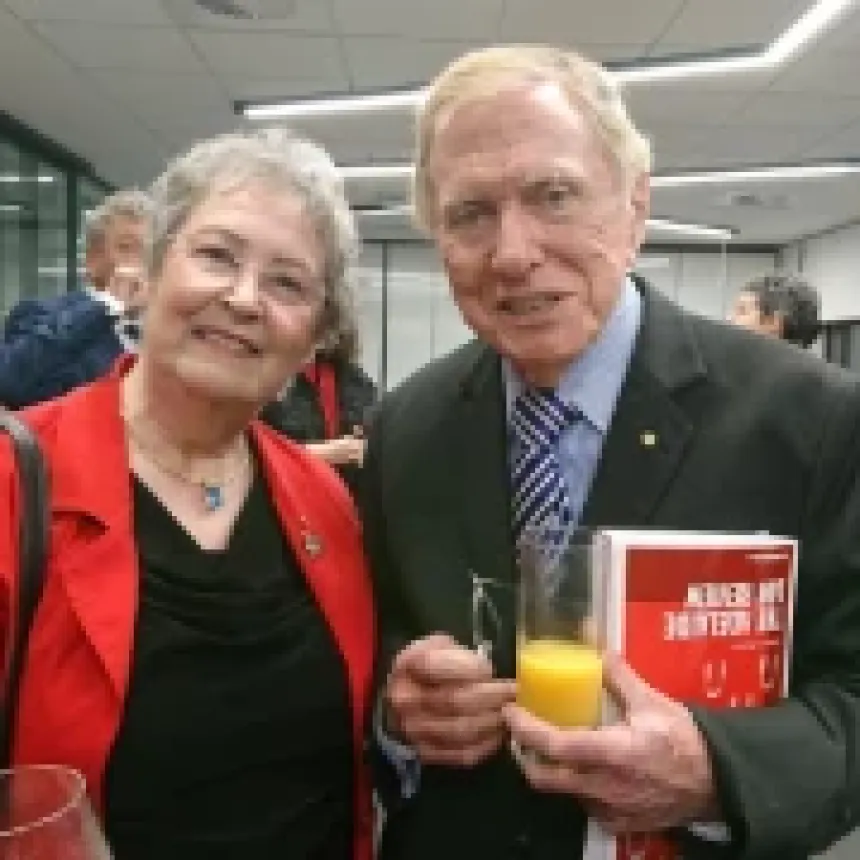
Dr Pamela Schulz OAM (pictured with the Hon Michael Kirby AC CMG) now is semi retired and continues to mentor students and write research papers and articles related to her specialty.... Discourse Analysis Communication Auditing and her keen interest in Justice and the Rule of Law. She gives regular expert lectures to students and continues to advocate for the use of language in Public Relations and Communications Management issues. She has numerous published articles and has delivered many conference papers including Europe the USA and New Zealand in recent years. ABOUT HER BOOK Dr Pamela D Schulz, “Courts on Trial: Analysing and Managing the Discourses of Disapproval” Lit, Berlin (2010), 290 pages This new book draws upon a range of theories and social frameworks such as fear discourse, risk society, media agenda setting among others and the significance of language (Discourse Analysis) which swirls constantly around the justice system in modern western democracy. The author shows that this discussion is liberally laced with the Discourses of Disapproval Diminution and later moves to the Discourse of Direction where poll driven politicians use the negative public opinion formations to further their aims in using law and order as a platform to garner support. See the Honourable Michael Kirby AC CMG launch her book on tube by clicking on the links below. As well as convincingly showing how this is done Dr Schulz also discovers that despite years of effort on the part of the judiciary to facilitate with the media and actively supporting media access to courts the public opinion of judges as “too lenient” and “out of touch” and other negative reporting persists and shows clearly how judges have become the new “offenders” in the courts and are “othered” by discourse. In turn judges have themselves become captive and colonised by the unrelenting negativity and appear stymied in being able to “fix the problem”. The final chapter shows the reader how to monitor this trend easily via discourse analysis and use the power of linguistics to change the ways in which public opinion may be actively presented. It also provides an opportunity for judges for a way forward which may in fact by-pass media entirely and again allows them to take control of direct address to community in which they serve. The book is a powerful and timely defence of the independence of the judiciary and the justice system in modern democracies and has garnered interest world wide. The book crosses over between communications theory and legal studies and reflects both the author’s practical experience as a media liaison officer for courts and her academic expertise as a research scholar. The book should be mandatory reading for judges, journalists, social scientists, media and language scholars who are concerned at how discourses can be used to sway public opinion. It will be an excellent reference text for law, politics and communications courses. The book is highly praised in the foreword by David B Rottman PhD from the National Center for State Courts, USA and former High Court Judge of Australia the Hon. Michael Kirby AC CMG commends the empirical and a careful analysis which “has the power to change thinking and working at informing the public about courts”. Key words: Media, fear discourse, public opinion, politics, judiciary, judges and criticism, linguistics and community understanding. Published by Lit Verlag Munster Berlin London New York, the book is available through Unibooks in Australia, WH Smith Co Booksellers and Amazon.co.uk the Book Depository in the UK and Amazon.com in the USA. Personal Profile Pamela D Schulz.... Pamela Schulz has spent more than 25-years of her career in specialist communications management, public relations and community education as a senior practitioner within the South Australian Government Public Service. At present she conducts a small private consultancy which assists organisations that have difficulty in communicating their message in a cluttered and difficult (saturated) environment. Married to Roy she has four grown children all in careers of their own. It is interesting to note that three of them are in careers linked to communication. From her earliest years as a radio journalist to sociology and teaching to eventually returning to her first love she has been involved in communication. Pamela has held positions as a senior marketing and communication management specialist as well as a public relations manager within a wide range of private and mostly public sector organisations. Her major focus of attention has always been communication with community, media engagement and engaging with community groups that resist traditional communication activities related to the printed word or advertising as a major focus. Pamela conducted a major government campaign from mid 2002 to December 2003 to engage people in the area of Parliamentary and Constitutional Reform in the lead up to the South Australian Constitutional Convention. This campaign won a gold award for Government Communication from the Public Relations Institute of Australia. At present Pamela is a private consultant in communication management. She believes strongly in further education and assists where possible to promote communication as a profession to the wider community. Pamela has qualifications in Social Work, Communication and Education and has completed her Doctorate at the University of South Australia. Her topic was a language based analysis focussed on the public confidence in the justice system, public relations and courts. Since this time she has presented at more than 100 seminars and conferences both here in Australia and Abroad. Pamela has a particular interest in communication management and its implications for modern communication practices. In particular in a world of unrelenting media scrutiny, populist demands and public opinion formation the need to get your message out is crucial. This forms a major interest in her Doctoral Studies which she completed in late 2007 and was conferred in April 2008. Dr Schulz has taught in the graduate studies area in communication on shore at Magill Campus for over 20 years as a part time and sessional lecturer and as a course coordinator and Offshore lecturer for several years and is always keen to see the next generation of communication managers and communication specialists do well. Theoretical underpinning coupled with experience and practical application is the key according to Pamela whose decades long career reflect this view. Her focus in communications management is that there is more to the task than simple publicity and event management and that a keen application of solid theoretical underpinning will ensure excellence in practice. In her research Pamela has focussed widely on the use of language in settings and generation of public opinion and uses Discourse Analysis as part of her work as a private consultant. Her recent work has considered Defence and Justice issues. Dr Schulz is the immediate past Chair of the Defence Reserves Support Council SA and now acts as a supportive councillor to the present incumbent. This is a high profile group of employers drawn from all sectors in the state and advises directs and endorses strategies for engaging and supporting Employers of Reservists in South Australia. She was appointed for a three year term to 2012 by the Parliamentary Secretary of Defence.In 2012 Dr Schulz was re appointed for another three year term to 2015 Dr Schulz has just completed her third term as a Member of the Veterans Advisory Council of SA appointed by the SA Minister for Veterans Affairs and Defence Industries. In 2013 Dr Pamela Schulz was awarded the Order of Australia Medal in the Queens Birthday Honours List for her work in providing public relations to a number of charities and organisations.
I have completed research and issues related to public opinion of courts in Australia. In addition I am examining the effects that the judiciary can have on public relations practice and people's understanding of courts.,I have a more than passing interest in understanding why young women are more interested in public relations in Australia.,I have done work in a particular area of interest in the formation of public opinion through the construction of discourses. This involves researching language used to initiate and engage people to a point of view.
Connect With Me

Available For Media Comment.