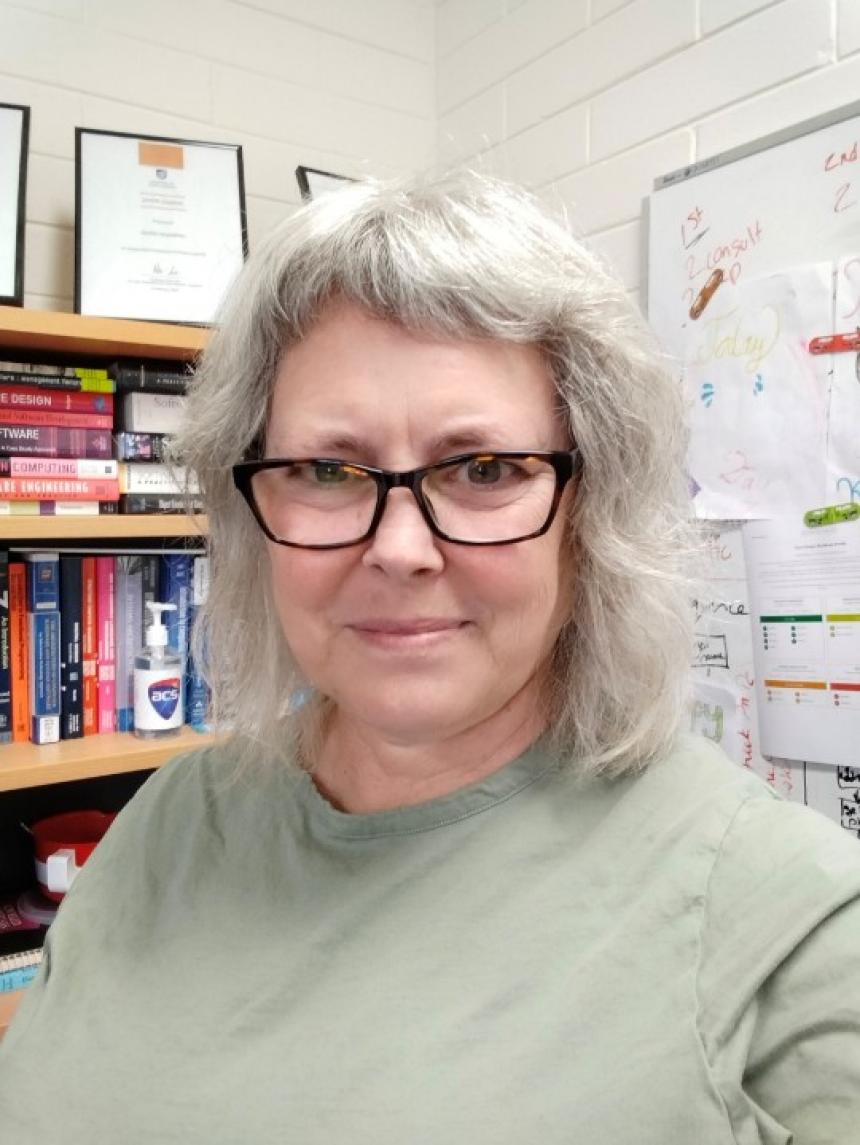
Dr Kirsten Wahlstrom (she/her) is an academic focussed on research and teaching, and a Certified Professional registered with the Australian Computer Society. While Kirsten acknowledges the privileges that flow from her education, being cis, white, and from her Australian citizenship, as a child and young woman she experienced low-SES circumstances and as a woman in IT, she has sometimes been marginalised and unheard.
Kirsten's research aims to perpetuate well-being and to enable others to thrive in technosocial contexts. This involves revealing the effects of emerging technologies on social constructs. More recently, her research has evolved to take a greater focus on the human factors aspects of cybersecurity.
She was the principal supervisor of Dr Lukman Purnomo and Dr Alice Crawley, and the Advisor of Dr Anisha Fernando. Dr Purnomo studied risk management in zero trust environments, Dr Crawley studied fake news in the wider context of public discourse, and Dr Fernando studied personalisation and search.
Kirsten's current doctoral students are listed below. She has been a co-investigator on four successful grants, three of which funded the doctoral research of Dr Fernando, Dr Crowley, and Mark Carman, and the fourth which funds a T&L research project.
Kirsten's research commitments are reflected in her service, and she contributes to the research community on the Editorial Board of the Journal of Information,Communication and Ethics in Society. She has been a Section Editor for the Australasian Journal of Information Systems and she chaired the organising committee of the 2020 conference of the Australasian Institute of Computer Ethics. In 2025, she chaired the Values and Affordances track at the ETHICOMP conference, and in 2021 she chaired its Between and Beyond Codes of Ethics track and was on the conference's keynote panel. She is a past chair of the Australian Computer Society's Professional Ethics Committee and has been a member of its Profession Advisory Board.
Kirsten’s doctoral research was conducted at the Centre for Computing and Social Responsibility at De Montfort University in Leicester, under the supervision of Dr Ben Fairweather, Assoc Prof Helen Ashman, Dr Sara Wilford, Prof Kathleen Richardson, and Mr Howell Istance. In this research, Kirsten developed and applied a novel method informed by critical social theory to investigate the ways in which Brain-Computer Interfaces disrupt privacy. That method was triangulated with Nissenbaum's contextual integrity approach to identifying privacy disruptions. Findings were reported in four conference papers and one journal paper, all of which are listed on her Google Scholar profile, along with various other publications.
Throughout her career, Kirsten has taught large cohorts of commencing first year students. She holds five awards for outstanding teaching practice, among them a national award for providing experiential learning to transnational teams of students. She invites authentic learning through the active, team-based and experiential pedagogies, engaging students in purposive learning and critical reflection. Kirsten’s teaching is also characterised by collaborations in which her professional colleagues play an important role, giving talks, providing and supervising projects, coaching students, providing placements, and more. Most importantly of all, Kirsten works with Aboriginal tutors and clients in the first year course she coordinates, privileging their voices.
Throughout her teaching, Kirsten has received positive feedback from students. A recent anonymous student commented, "An amazing educator - Kirsten shines in her role as lecturer and workshop presenter. She knows the material very well and has a true passion for the concepts and the potential of what this course can deliver. She is enthusiastic and tries to pass that on to her students. Thanks Kirsten." Another commented, "Absolutely fantastic instructor. Cannot fathom the time she spends on the course and making it interesting, exciting and beneficial to her students. Completely respectful and understanding of all kinds of needs. Knew the course off the back of her hand and kept the class in tow. By far the best instructor I have had so far."
Kirsten’s commitment and motivation emerge from her feminist principles which motivate respect for others, inclusivity, intellectual engagement, and social responsibility. In her free time, she prioritises her family, she renovates the house her great-grandfather built, and she maintains a vibrant and diverse social network.