
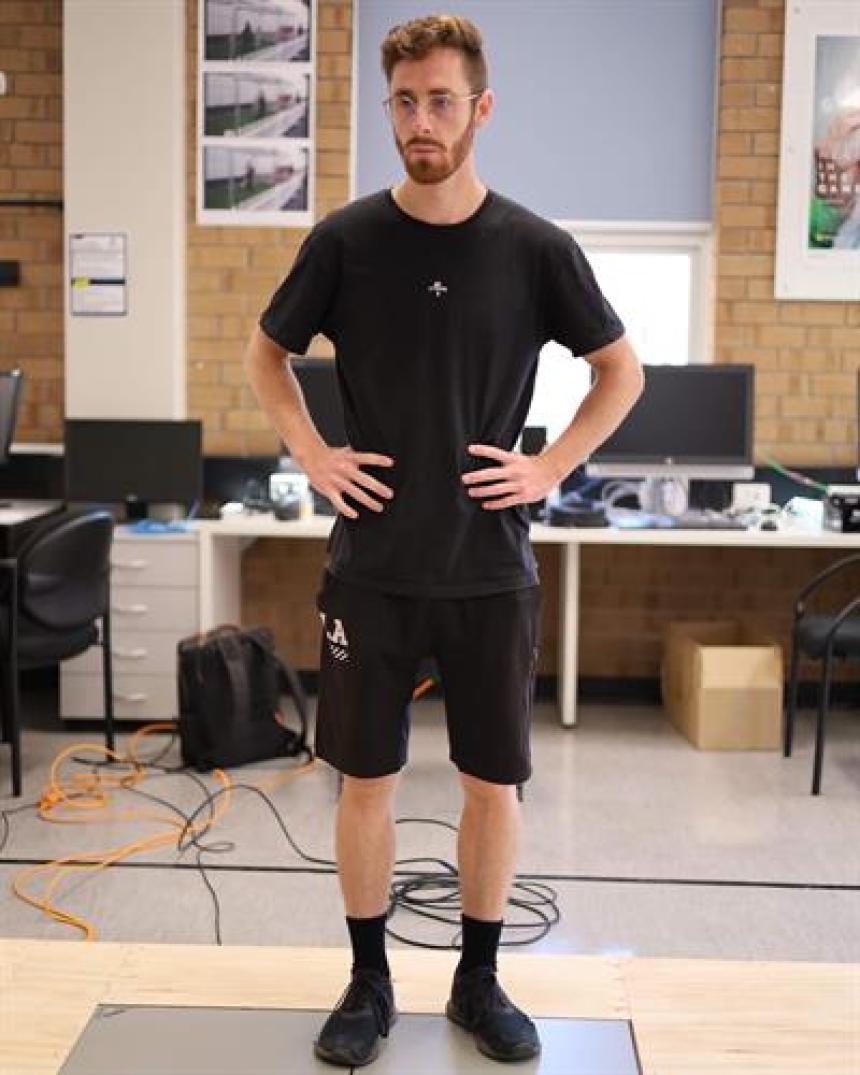
Mr Kayne Duncanson
Higher Degree by Research Candidate
School of Medicine
College of Health
Our team is conducting multi-disciplinary research on the application of artificial intelligence to human gait analysis. Specifically, we are developing and evaluating machine learning models that identify people based on how they apply force through their feet while walking. Previously, as part of my Honours project, I contributed to a research project on the mechanical and energetic effects of altered arch stiffness during human locomotion. I am passionate about research areas at the intersection of Human and Computer Sciences, such as Artificial Intelligence, Biomechanics and Biometrics.
Our team is conducting multi-disciplinary research on the application of artificial intelligence to human gait analysis. Specifically, we are developing and evaluating machine learning models that identify people based on how they apply force through their feet while walking. Previously, as part of my Honours project, I contributed to a research project on the mechanical and energetic effects of altered arch stiffness during human locomotion. I am passionate about research areas at the intersection of Human and Computer Sciences, such as Artificial Intelligence, Biomechanics and Biometrics.
| Date | Position | Institution name |
|---|---|---|
| 2020 - 2023 | PhD Candidate | University of Adelaide |
| Language | Competency |
|---|---|
| English | Can read, write, speak, understand spoken and peer review |
| Date | Institution name | Country | Title |
|---|---|---|---|
| 2014 - 2019 | University of Queensland | Australia | Bachelor of Exercise and Nutrition Sciences (Honours) |
| Date | Title | Institution name | Country |
|---|---|---|---|
| 2020 | Deep Learning Specialization | deeplearning.ai | - |
| Year | Citation |
|---|---|
| 2024 | Duncanson, K. A., Horst, F., Abbasnejad, E., Hanly, G., Robertson, W. S. P., & Thewlis, D. (2024). Modelling individual variation in human walking gait across populations and walking conditions via gait recognition. Journal of the Royal Society Interface, 21(221), 20240565-1-20240565-15. Scopus5 WoS3 Europe PMC2 |
| 2023 | Duncanson, K. A., Thwaites, S., Booth, D., Hanly, G., Abbasnejad, E., Robertson, W. S. P., & Thewlis, D. (2023). Deep Metric Learning for Scalable Gait-Based Person Re-Identification Using Force Platform Data. Sensors, 23(7), 3392. Scopus17 WoS10 Europe PMC6 |
| 2021 | Duncanson, K., Thwaites, S., Booth, D., Abbasnejad, E., Robertson, W., & Thewlis, D. (2021). The Most Discriminant Components of Force Platform Data for Gait Based Person Re-identification. |
| Year | Citation |
|---|---|
| 2026 | Duncanson, K., Badger, H., Krywanio, M., Abbasnejad, E., Hanly, G., Robertson, W., & Thewlis, D. (2026). ForceID-B - A diverse walking ground reaction force dataset acquired in a public indoor setting. DOI |
| 2022 | Duncanson, K., Thwaites, S., Booth, D., Hanly, G., Robertson, W., Abbasnejad, E., & Thewlis, D. (2022). ForceID Dataset A. DOI |
| Year | Citation |
|---|---|
| 2021 | Duncanson, K., Thwaites, S., Booth, D., Abbasnejad, E., Robertson, W., & Thewlis, D. (2021). The Most Discriminant Components of Force Platform Data for Gait Based Person Re-identification. DOI |
Australian Government Research Training Program Stipend;
Defence Science and Technology Group;
National Health and Medical Research Council (ID: 1126229).
In 2019, I was a practical demonstrator for first and second year Biomechanics at the University of Queensland. I tutored 120+ students and assisted with examination marking. Prior to that, I tutored small groups at University of Queensland colleges and assisted over two-dozen independent students.
I love teaching because it allows me to meet new people and engage in mutual learning and inspiration through the sharing of knowledge and ideas (not just on content, but also on the philosophy and methodology of learning). Teaching is a great way to encourage new patterns of thought and behaviour that can redefine our lives.
| Date | Role | Membership | Country |
|---|---|---|---|
| 2021 - ongoing | Member | International Society of Biomechanics | Australia |
Connect With Me

External Profiles
