

Teaching Strengths
Dr Irene Bolognino
Lecturer
School of Physics, Chemistry and Earth Sciences
College of Science
Eligible to supervise Masters and PhD as Principal Supervisor, but is currently at capacity - email supervisor to discuss availability.
I am an experimental astroparticle physicist and Lecturer at Adelaide University, specialising in dark matter searches, neutrino physics and particle detector development. My research combines advanced photodetection technologies, low-background instrumentation, Monte Carlo simulations and data analysis. As the first female academic appointed in particle physics at Adelaide University, I am committed to advancing experimental research, developing new scientific capabilities and supporting the next generation of physicists.
Before pursuing my academic career, I gained several years of experience in the aerospace, defence and automotive industries, including coordinating aspects of aircraft assembly for the F-35 programme and conducting research on advanced stealth coatings. This experience strengthened my expertise in advanced materials, precision engineering and the coordination of complex technical projects, complementing my academic research in experimental physics. My career has also enabled me to build an extensive international network across academia, research laboratories and industry.
Beyond my research, I contribute to the wider physics community through scientific leadership, mentoring and professional service. I serve on the Nuclear and Particle Physics Committee of the Australian Institute of Physics and contribute to mentoring initiatives within the ARC Centre of Excellence for Dark Matter Particle Physics. I am particularly committed to fostering an inclusive research environment, supporting early-career researchers and creating opportunities for students to develop their scientific independence.
My research focuses on experimental astroparticle physics, with particular emphasis on dark matter detection, neutrino physics and the development of advanced particle detectors. I combine low-background experimental techniques, photodetection, detector calibration, Monte Carlo simulations and data analysis to investigate fundamental questions in particle physics.
A central aspect of my work is the development of experimental capabilities and research infrastructure, connecting major international collaborations with locally led research programmes at Adelaide University. My activities span dark matter direct and directional detection, liquid-scintillator instrumentation, quantum sensing and interdisciplinary applications of ultra-low-light photodetection. Through these programmes, I lead detector development and calibration activities, establish international research partnerships and provide opportunities for students and early-career researchers to gain hands-on experience in experimental physics.
My research extends beyond Adelaide through major international collaborations. I serve on the Executive Board of NEXUS, a consortium funded through the Horizon Europe Marie Skłodowska-Curie Actions Staff Exchanges programme, where I co-lead the Quantum Science and Technology Work Package and contribute to research on muon- and neutron-induced backgrounds in underground laboratories. I actively foster international and interdisciplinary collaborations, bringing together complementary expertise to address the challenges of next-generation rare-event physics experiments.
Beyond research, I am committed to scientific leadership, mentoring and community building. I serve on the Nuclear and Particle Physics Committee of the Australian Institute of Physics and on the Mentoring Committee of the ARC Centre of Excellence for Dark Matter Particle Physics. I believe that scientific excellence benefits from collaboration, diversity and inclusion, and I actively support initiatives that create opportunities for students, early-career researchers and under-represented groups in STEM.
Students interested in experimental astroparticle physics are very welcome to get in touch to discuss research opportunities, ranging from hands-on experimental work to data analysis and simulations.
Dark matter direct detection
Dark matter is one of the greatest mysteries in modern physics. Although it is thought to account for approximately 85% of the matter in the Universe, its nature remains unknown. My research focuses on developing and operating highly sensitive detectors designed to search for dark matter particles and distinguish potential signals from background radiation.
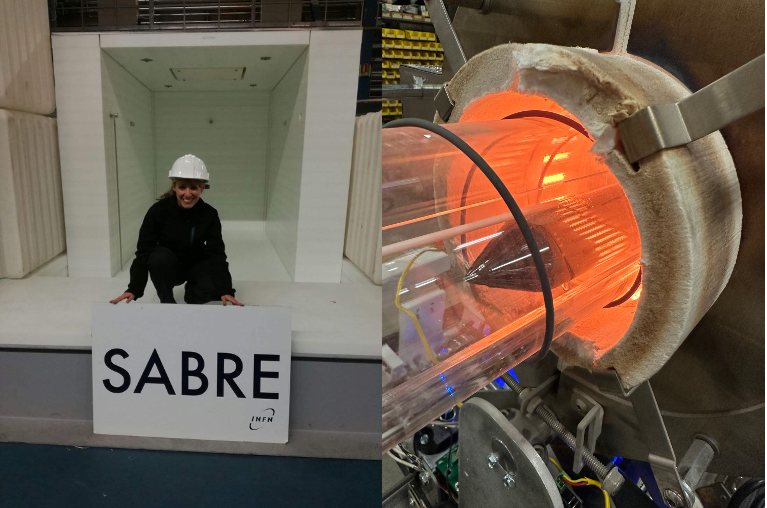
SABRE South
I am a member of the ARC Centre of Excellence for Dark Matter Particle Physics and play a leading role in the international SABRE collaboration, which aims to investigate the long-standing DAMA/LIBRA annual modulation signal. SABRE comprises two complementary low-background sodium-iodide experiments: SABRE North, located at the Laboratori Nazionali del Gran Sasso (LNGS) in Italy, and SABRE South, located at the Stawell Underground Physics Laboratory (SUPL) in Victoria, Australia.
Within SABRE South, I lead the detector calibration programme, coordinating the development and implementation of techniques essential for understanding detector performance and identifying potential dark matter signals. I am also part of the SABRE Speakers Committee, coordinating the presentation of collaboration results at international scientific conferences.
Having worked directly on both SABRE North and SABRE South, I bring experience in detector assembly, commissioning, calibration and characterisation. My affiliation with INFN Milano strengthens the scientific connections between the Australian and Italian research communities.
For students, SABRE offers opportunities to work on real experimental challenges, from photodetector characterisation and calibration to Monte Carlo simulations, signal processing and data analysis. These activities provide experience with the technologies and techniques used in some of the world's most sensitive particle physics experiments.
Curious about SABRE? Watch the video Veritasium made about SABRE South https://www.youtube.com/watch?v=6etTERFUlUI
Cygnus-Oz
I am also involved in the international CYGNUS collaboration, which is developing a new generation of detectors capable of reconstructing the direction of low-energy nuclear recoils. Unlike conventional dark matter detectors, directional detectors aim to identify the direction from which potential dark matter particles arrive, providing an additional way to distinguish dark matter interactions from background events.
As part of CYGNUS-Oz, we are developing experimental capabilities in Adelaide to investigate Micromegas-based gaseous detectors, which can reconstruct particle tracks with high spatial resolution.
This research involves detector development, readout electronics, data acquisition, track reconstruction and background rejection techniques. It offers students opportunities to contribute to emerging detector technologies while developing practical skills in experimental physics, simulations and data analysis.
R&D Developments at Adelaide University
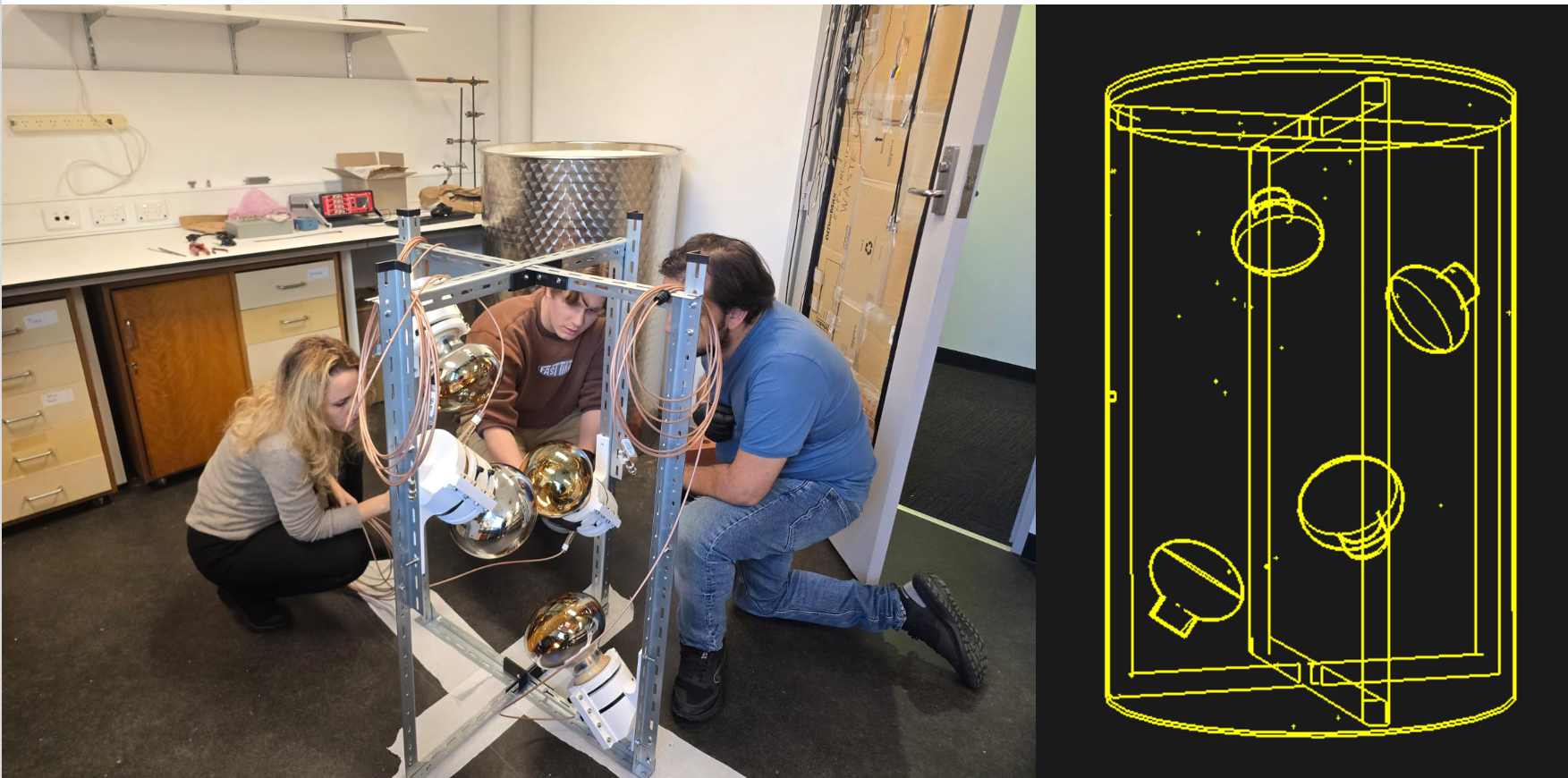
A central component of my independent research programme is MonA LiSA, a liquid-scintillator research facility that I established and lead as Principal Investigator. Developed through competitive research funding, MonA LiSA provides a flexible experimental platform for testing detector technologies and calibration techniques before their implementation in large-scale underground experiments.
The facility allows us to investigate photomultiplier tube (PMT) performance, develop precision optical calibration techniques and study light propagation in liquid scintillators. We also develop reconstruction algorithms for sparse detector geometries and investigate cosmic-ray-induced signals. Beyond its original purpose as an optical testbed, MonA LiSA is evolving into a platform for detector prototyping and interdisciplinary research involving ultra-low-light detection.
Students working on MonA LiSA gain extensive hands-on experience, from detector assembly and electronics to data acquisition, signal processing, simulations and analysis. They participate directly in the development and operation of a research detector, acquiring practical skills in experimental physics and instrumentation.
Complementing MonA LiSA, I am expanding a dedicated Photonics and Photosensor Test Bench at Adelaide University's North Terrace campus. This facility supports the characterisation of photodetectors, including traditional PMTs and silicon photomultipliers (SiPMs), using precision laser systems, optical fibres, calibrated light sources and light-tight enclosures.
The test bench enables measurements of key detector properties, including timing resolution, gain, photon-detection efficiency, dark noise and afterpulsing. It also supports investigations of optical materials, light coupling, wavelength shifters and novel calibration techniques.
Students involved in these activities develop practical expertise in optical alignment, laser systems, digitiser configuration, data acquisition software and precision measurements under low-light conditions.
Together, MonA LiSA and the photonics test bench provide an integrated research and training environment, connecting fundamental photosensor characterisation with the development and testing of complete detector concepts. These projects equip students with transferable skills in instrumentation, electronics, photonics and data analysis, relevant to careers in both academia and industry.
Quantum technologies
In parallel to my astroparticle work, I am strongly involved in quantum technologies, where I apply low-background detector techniques to the development of next-generation quantum sensors. I am co-leader of a Horizon Europe Marie Curie Staff Exchange that links underground physics with quantum science, focusing on superconducting devices, ultra-low-noise readout systems, and advanced cryogenic instrumentation. This program allows students and researchers to work across Europe, Australia and the US, forming a bridge between particle physics and the rapidly growing quantum-technology sector.
In 2025, I secured additional funding to open a new research line on quantum measurements using the MonA LiSA facility. This project explores how a fully controlled scintillator detector can be used to test quantum-level light emission and ultra-low-photon processes, taking advantage of MonA LiSA’s radiopure environment and precision calibration system. By combining quantum optics, photon statistics, and detector physics, the project creates a unique training ground where students can work hands-on with lasers, single-photon sensors, and state-of-the-art electronics, while contributing to cutting-edge research that connects fundamental physics with quantum technology applications.
Neutrino Physics
Neutrinos are among the most elusive particles in the Universe. They interact extremely weakly with matter, allowing them to travel enormous distances almost undisturbed and carry valuable information about some of the most extreme environments in the cosmos. My research in neutrino physics spans solar and reactor neutrino experiments, including Borexino and SoLid, where I worked on detector development, calibration and data analysis.
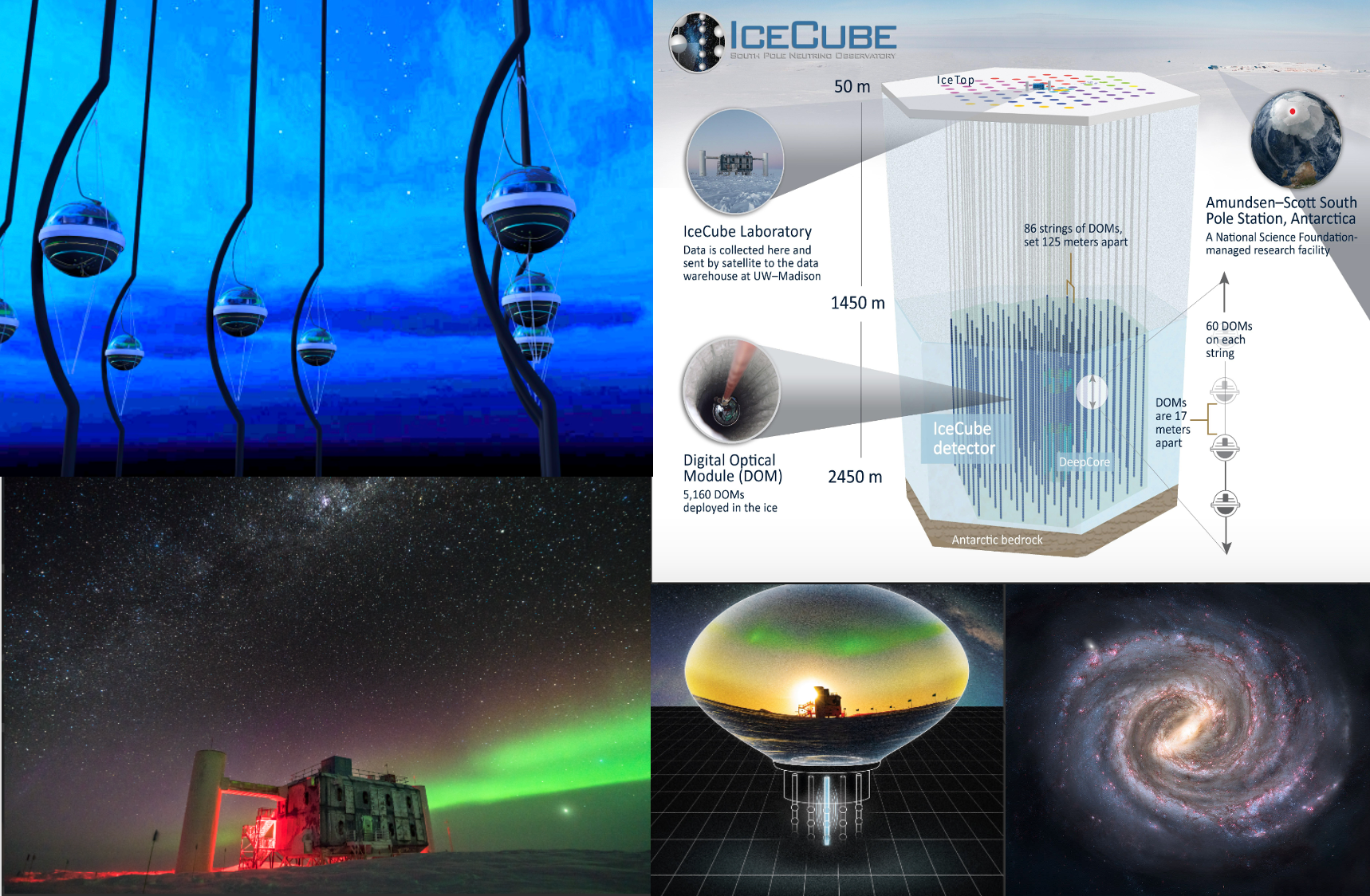
I am also involved in the IceCube Neutrino Observatory, a remarkable detector embedded deep within the Antarctic ice. IceCube uses thousands of optical sensors to detect the faint light produced by particles created when neutrinos interact with the ice. By studying these signals, we can investigate the origins of high-energy cosmic neutrinos, explore fundamental particle physics and search for potential signatures of dark matter.
For students interested in neutrino physics, IceCube offers opportunities to work with experimental data, develop simulations and explore how we reconstruct and interpret signals from particles travelling across the Universe. These projects are particularly suited to students who enjoy programming, data analysis and tackling fundamental questions in physics.
LiDiR: Ultra-Sensitive Light Detectors System to Advance Multidisciplinary Research
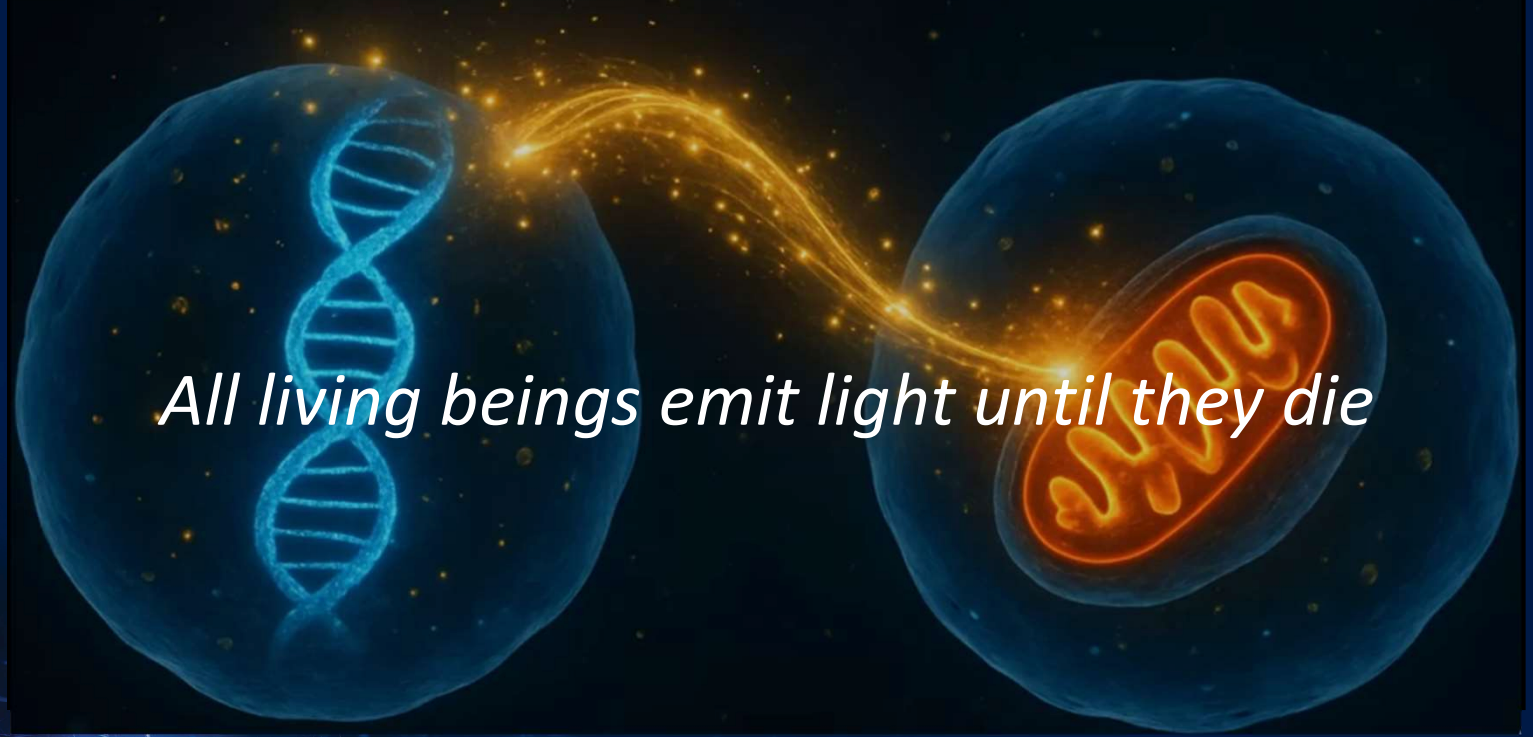
Can living cells emit light? Surprisingly, they can! Biological systems produce extremely faint light, known as ultra-weak photon emission or biophotons, which is far too weak to be detected by the human eye. Understanding how this light is produced, what influences it and whether it carries information about biological processes remains an exciting area of research.
Through LiDiR, an interdisciplinary research initiative that I lead, we are exploring how ultra-sensitive photodetection technologies originally developed for dark matter and neutrino experiments can be applied to the study of biophoton emission. By combining single-photon detectors, low-background experimental techniques and advanced data analysis, we aim to measure these extremely faint signals and investigate their possible connections with cellular metabolism and stress.
LiDiR brings together physics, photonics and the life sciences, offering students the opportunity to work on an emerging research topic with applications beyond fundamental particle physics. Projects may involve developing optical detection systems, designing experiments, analysing photon signals and exploring how precision measurements can help us better understand biological processes.
Science Communication and Outreach
Communicating science is an important part of my work. I regularly present my research at international conferences and research institutions worldwide, sharing developments in dark matter detection, neutrino physics and advanced detector technologies.
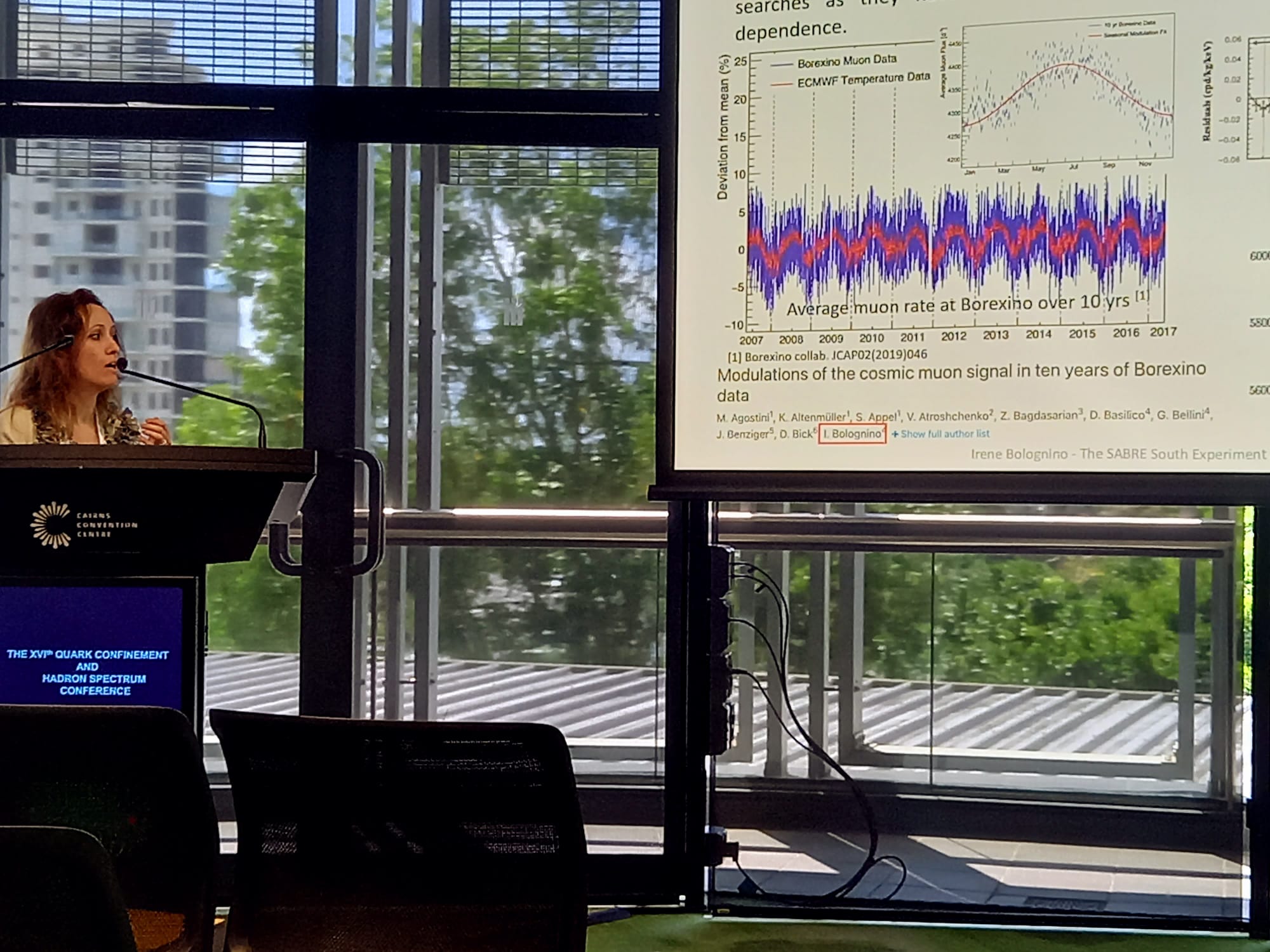
I enjoy sharing my passion for physics and making astroparticle physics accessible, exciting and inspiring for students and the general public. Over the years, I have developed and delivered a wide range of outreach activities, from hands-on photonics workshops to public lectures and national science events, across Australia and internationally.
I regularly introduce high-school students to the fascinating world of dark matter detection, exploring the scientific questions and experimental techniques behind the search for one of the Universe's greatest mysteries. These activities include interactive sessions at Liceo Scientifico Cattaneo and other schools in Torino and the surrounding regions. For younger students, I design and lead hands-on optics and photonics activities through Children's University in Adelaide, giving them the opportunity to explore light, sensors and the technologies used in modern physics experiments.
I have also delivered professional development sessions for the South Australian Science Teachers Association (SASTA) in collaboration with the AIP SA Branch, sharing practical demonstrations and classroom-ready experiments in photonics and particle detection.
I coordinated the Adelaide programme of the Women in Physics Tour, bringing together a public lecture, secondary-school outreach and opportunities for visiting physicists to engage with university students and research groups. Through initiatives like this, I aim to encourage greater participation in physics and inspire young people, particularly girls and young women, to consider careers in STEM.
I also gave public lectures, including
• “The Hunt for Dark Matter in a Gold Mine in Australia” for the Astronomical Society of South Australia
• A talk about dark matter direct detection as part of the National Quantum and Dark Matter Road Trip, bringing physics to communities across the country.
My work has been featured in the media, including the COSMOS magazine interview “Why dark matter matters” (link: https://cosmosmagazine.com/science/why-dark-matter-matters/).
I have also participated in initiatives such as the ARC Centre of Excellence’s “Meet the Researcher”, discussing my scientific path and the motivations that led me into physics (link: https://www.centredarkmatter.org/all/https/meet-the-researcher-irene-fbolognino-7ekyh-4x5nh).
If you are a student curious about the Universe—whether you enjoy hands-on experimentation, optical setups, data analysis, simulations, or simply asking big questions—there will always be a place for you in my group.
| Date | Position | Institution name |
|---|---|---|
| 2023 - ongoing | Lecturer | University of Adelaide |
| 2022 - 2023 | Postdoctoral Research Fellow | University of Adelaide |
| 2020 - 2022 | Visitor Scientist | University of Adelaide |
| 2018 - 2020 | Post Doctoral Research Fellow | Laboratoire de Physique Subatomique et des Technologies Associées |
| 2017 - 2018 | Postdoctoral Research Fellow | University of Milan |
| Date | Type | Title | Institution Name | Country | Amount |
|---|---|---|---|---|---|
| 2022 | Award | ARC Dark Matter Centre's Collaboration and Values Award | ARC Centre of Excellence for Dark Matter and Particle Physics | Australia | - |
| Language | Competency |
|---|---|
| French | Can read, write, speak, understand spoken and peer review |
| Italian | Can read, write, speak, understand spoken and peer review |
| Date | Institution name | Country | Title |
|---|---|---|---|
| University of Pavia | Italy | PhD (Astroparticle Physics) | |
| University of Turin | Italy | M.Sc. (Astrophysics and Cosmic Physics) , awarded the Executive Dean's Recognition of Academic Excel | |
| University of Turin | Italy | B.Sc (Physics) |
| Date | Title | Institution | Country |
|---|---|---|---|
| 2022 | Leading Edge, Woman & Leadership Australia (WLA). | Woman & Leadership Australia (WLA). | Australia |
| 2019 | Advance training on teaching techniques | eCampus University | Italy |
| 2019 | Advanced Software Programming for Astronomy, Astrophysics and Particle Physics International School | Laboratoire d'Annecy-le-Vieux de physique des particules | France |
| 2019 | PHYSTAT-nu 2019 | CERN | Switzerland |
| 2018 | Dark Matter Advanced Training Institute | University of California, Los Angeles | United States |
| 2017 | Seminar on Software for Nuclear, Sub-nuclear and Applied Physics | INFN | Italy |
| Year | Citation |
|---|---|
| 2026 | Fu, G., Mews, M., Scutti, F., Urquijo, P., Barberio, E., Bashu, V., . . . Zhong, Y. Y. (2026). Measurement of the cosmic muon flux at the Stawell Underground Physics Laboratory. Astroparticle Physics, 179, 103240. |
| 2025 | Barberio, E., Baroncelli, T., Bashu, V. U., Bignell, L. J., Bolognino, I., Brooks, G., . . . Zurowski, M. J. (2025). The SABRE South technical design report executive summary. Journal of Instrumentation, 20(4), T04001-1-T04001-40. Scopus9 WoS7 |
| 2025 | Abreu, Y., Amhis, Y., Arnold, L., Beaumont, W., Bolognino, I., Bongrand, M., . . . Yermia, F. (2025). Search for very-short-baseline oscillations of reactor antineutrinos with the SoLid detector. Physical Review D, 111(7), 8 pages. Scopus2 WoS2 |
| 2025 | Milligan, L. J., Urquijo, P., Barberio, E., Bashu, V. U., Bignell, L. J., Bolognino, I., . . . Zurowski, M. J. (2025). Photomultiplier requirements and pre-calibration for the SABRE South Liquid Scintillator Veto. Journal of Instrumentation, 20(07), P07049-0-P07049-28. Scopus1 |
| 2025 | Stanley, O., Melbourne, W. J. D., Urquijo, P., Barberio, E., Bashu, V. U., Bignell, L. J., . . . Zhong, Y. Y. (2025). Characterisation of Hamamatsu R11065-20 PMTs for use in the SABRE South NaI(Tl) Crystal Detectors. Journal of Instrumentation, 20(07), P07052-1-P07052-31. Scopus2 |
| 2025 | Abreu, Y., Amhis, Y., Arnold, L., Barber, G., Beaumont, W., Binet, S., . . . Yermia, F. (2025). Electromagnetic energy calibration of the SoLid detector with horizontal muons. Journal of Instrumentation, 20(10), 27 pages. |
| 2024 | Curceanu, C., Napolitano, F., Bazzi, M., Bolognino, I., Bortolotti, N., Clozza, A., . . . Thomas, A. W. (2024). PANTHEON: TOWARDS HIGH-PRECISION TESTS OF THE PAULI EXCLUSION PRINCIPLE IN NUCLEAR REACTION AS A TESTBED OF THEORIES BEYOND THE STANDARD MODEL. Acta Physica Polonica B, Proceedings Supplement, 17(1), 1A61-1A67. |
| 2024 | Abreu, Y., Amhis, Y., Arnold, L., Barber, G., Beaumont, W., Binet, S., . . . Yermia, F. (2024). The CCube reconstruction algorithm for the SoLid experiment. Nuclear Instruments and Methods in Physics Research, Section A: Accelerators, Spectrometers, Detectors and Associated Equipment, 1066, 169628. Scopus2 WoS1 |
| 2023 | Barberio, E., Baroncelli, T., Bignell, L. J., Bolognino, I., Brooks, G., Dastgiri, F., . . . Zurowski, M. J. (2023). Simulation and background characterisation of the SABRE South experiment. The European Physical Journal C, 83(9), 878-1-878-16. Scopus16 WoS12 |
| 2021 | Abreu, Y., Amhis, Y., Arnold, L., Barber, G., Beaumont, W., Binet, S., . . . Yermia, F. (2021). SoLid: A short baseline reactor neutrino experiment. Journal of Instrumentation, 16(2), P02025-1-P02025-40. Scopus39 WoS30 |
| 2021 | Antonello, M., Arnquist, I. J., Barberio, E., Baroncelli, T., Benziger, J., Bignell, L. J., . . . Zurowski, M. (2021). Characterization of SABRE crystal NaI-33 with direct underground counting. European Physical Journal C, 81(4), 299-1-299-11. Scopus26 WoS27 |
| 2019 | Antonello, M., Barberio, E., Baroncelli, T., Benziger, J., Bignell, L. J., Bolognino, I., . . . The SABRE Collaboration. (2019). Monte Carlo simulation of the SABRE PoP background. Astroparticle Physics, 106, 1-9. Scopus27 WoS30 |
| 2019 | Antonello, M., Barberio, E., Baroncelli, T., Benziger, J., Bignell, L. J., Bolognino, I., . . . Xu, J. (2019). The SABRE project and the SABRE Proof-of-Principle. European Physical Journal C, 79(4), 8 pages. Scopus92 WoS88 |
| 2019 | Agostini, M., Altenmüller, K., Appel, S., Atroshchenko, V., Bagdasarian, Z., Basilico, D., . . . Tartaglia, R. (2019). Modulations of the cosmic muon signal in ten years of Borexino data. Journal of Cosmology and Astroparticle Physics, 2019(2), 30 pages. Scopus44 WoS43 |
| 2019 | Miramonti, L. (2019). Recent results on pp-chain solar neutrinos with the Borexino detector. |
| 2018 | Miramonti, L., Agostini, M., Altenmueller, K., Appel, S., Atroshchenko, V., Bagdasarian, Z., . . . Vishneva, A. (2018). Solar neutrinos spectroscopy with borexino phase-II. Universe, 4(11), 14 pages. Scopus2 |
| 2014 | Bartoli, B., Bernardini, P., Bi, X. J., Bolognino, I., Branchini, P., Budano, A., . . . Zizzi, G. (2014). Radon contribution to single particle counts of the ARGO-YBJ detector. Radiation Measurements, 68, 42-48. Scopus2 WoS2 |
| 2014 | Bartoli, B., Bernardini, P., Bi, X. J., Bolognino, I., Branchini, P., Budano, A., . . . Zuo, X. (2014). Energy spectrum of cosmic protons and helium nuclei by a hybrid measurement at 4300 m a.s.l.. Chinese Physics C, 38(4), 7 pages. Scopus50 WoS32 |
| 2014 | Bartoli, B., Bernardini, P., Bi, X. J., Bolognino, I., Branchini, P., Budano, A., . . . Zizzi, G. (2014). Evidence of a geomagnetic effect on extensive air showers detected with the ARGO-YBJ experiment. Physical Review D Particles Fields Gravitation and Cosmology, 89(5), 11 pages. Scopus9 WoS5 |
| 2013 | Bartoli, B., Bernardini, P., Bi, X. J., Bolognino, I., Branchini, P., Budano, A., . . . Zizzi, A. G. (2013). TeV gamma-ray survey of the northern sky using the ARGO-YBJ detector. Astrophysical Journal, 779(1), 10 pages. Scopus79 WoS69 |
| 2013 | Bartoli, B., Bernardini, P., Bi, X. J., Bolognino, I., Branchini, P., Budano, A., . . . Zizzi, G. (2013). Medium scale anisotropy in the TeV cosmic ray flux observed by ARGO-YBJ. Physical Review D Particles Fields Gravitation and Cosmology, 88(8), 12 pages. Scopus88 WoS73 |
| 2013 | Bartoli, B., Bernardini, P., Bi, X. J., Bolognino, I., Branchini, P., Budano, A., . . . Zhu, F. R. (2013). Observation of tev gamma rays from the unidentified source hess J1841-055 with the ARGO-YBJ Experiment. Astrophysical Journal, 767(2), 6 pages. Scopus30 WoS24 |
| 2012 | Bartoli, B., Bernardini, P., Bi, X. J., Bleve, C., Bolognino, I., Branchini, P., . . . Zhou, X. X. (2012). Observation of the TeV gamma-ray source MGRO J1908+06 with ARGO-YBJ. Astrophysical Journal, 760(2), 6 pages. Scopus48 WoS39 |
| 2012 | Bartoli, B., Bernardini, P., Bi, X. J., Bleve, C., Bolognino, I., Branchini, P., . . . Zhou, X. X. (2012). Long-term monitoring of mrk 501 for its very high energy γ emission and a flare in 2011 october. Astrophysical Journal, 758(1), 8 pages. Scopus71 WoS57 |
| 2012 | Bartoli, B., Bernardini, P., Bi, X. J., Bleve, C., Bolognino, I., Branchini, P., . . . Zhu, F. R. (2012). Light-component spectrum of the primary cosmic rays in the multi-TeV region measured by the ARGO-YBJ experiment. Physical Review D Particles Fields Gravitation and Cosmology, 85(9), 10 pages. Scopus78 WoS54 |
| 2012 | Bartoli, B., Bernardini, P., Bi, X. J., Bleve, C., Bolognino, I., Branchini, P., . . . Zhou, X. X. (2012). Observation of TeV gamma rays from the cygnus region with the ARGO-YBJ experiment. Astrophysical Journal Letters, 745(2), 5 pages. Scopus66 WoS54 |
| 2012 | Bartoli, B., Bernardini, P., Bi, X. J., Bleve, C., Bolognino, I., Branchini, P., . . . Zhu, Q. Q. (2012). Measurement of the cosmic ray antiproton/proton flux ratio at TeV energies with the ARGO-YBJ detector. Physical Review D Particles Fields Gravitation and Cosmology, 85(2), 10 pages. Scopus27 WoS24 |
| 2011 | Bartoli, B., Bernardini, P., Bi, X. J., Bleve, C., Bolognino, I., Branchini, P., . . . Zhang, X. Y. (2011). Early warning for VHE gamma-ray flares with the ARGO-YBJ detector. Nuclear Instruments and Methods in Physics Research Section A Accelerators Spectrometers Detectors and Associated Equipment, 659(1), 428-433. Scopus5 WoS3 |
| 2011 | Bartoli, B., Bernardini, P., Bi, X. J., Bleve, C., Bolognino, I., Branchini, P., . . . Zhaxiciren. (2011). Observation of the cosmic ray moon shadowing effect with the ARGO-YBJ experiment. Physical Review D Particles Fields Gravitation and Cosmology, 84(2), 15 pages. Scopus104 WoS73 |
| 2011 | Bartoli, B., Bernardini, P., Bi, X. J., Bleve, C., Bolognino, I., Branchini, P., . . . Zhang, X. Y. (2011). Long-term monitoring of the TeV emission from Mrk421 with the ARGO-YBJ experiment. Astrophysical Journal, 734(2), 8 pages. Scopus91 WoS64 |
| 2011 | Aielli, G., Bacci, C., Bartoli, B., Bernardini, P., Bi, X. J., Bleve, C., . . . Yuan, A. F. (2011). MEAN interplanetary magnetic field measurement using the ARGO-YBJ experiment. Astrophysical Journal, 729(2), 4 pages. Scopus42 WoS32 |
| 2011 | Bolognino, I. (2011). Gamma astronomy with ARGO-YBJ. Nuovo Cimento Della Societa Italiana Di Fisica C, 34(6), 348-349. |
| 2011 | Bolognino, I., Cattaneo, C., Giroletti, E., Liguori, G., & Salvini, P. (2011). Background radioactivity in the scaler mode technique of the Argo-YBJ detector. Astrophysics and Space Sciences Transactions, 7(3), 311-314. Scopus2 |
| Year | Citation |
|---|---|
| 2025 | Bolognino, I. (2025). The SABRE South Experiment at the Stawell Underground Physics Laboratory. In Proceedings of Science Vol. 501 (pp. 473). Sissa Medialab. DOI Scopus1 |
| 2024 | Barberio, E., Baroncelli, T., Bignell, L. J., Bolognino, I., Brooks, G., Dastgiri, F., . . . Zurowski, M. J. (2024). The SABRE South Experiment at the Stawell Underground Physics Laboratory. In Proceedings of the 38th International Cosmic Ray Conference (ICRC2023), as puiblished in Proceedings of Science Vol. 444 (pp. 1370-1-1370-8). Nagoya, Japan: SISSA. DOI Scopus1 |
| 2024 | Bolognino, I., Barberio, E., Baroncelli, T., Bignell, J. L., Bolognino, I., Brooks, G., . . . Zurowski, M. J. (2024). The SABRE South Experiment at the Stawell Underground Physics Laboratory. In Unknown Conference (pp. 159-166). Springer Nature Singapore. DOI |
| 2022 | Barberio, E., Baroncelli, T., Bignell, L. J., Bolognino, I., Brooks, G., Dastgiri, F., . . . Zurowski, M. J. (2022). The SABRE South experiment at the Stawell Underground Physics Laboratory. In Proceedings of the 41st International Conference on High Energy physics (ICHEP 2022 ), as published in Proceedings of Science Vol. 414 (pp. 1127-1-1127-4). Bologna, Italy: SISSA. DOI |
| 2020 | Bolognino, I. (2020). Direct search of dark matter with the sabre experiment. In Proceedings of the 53rd Rencontres de Moriond on Cosmology 2018 (pp. 319-322). online: Moriond. |
| 2019 | D'Imperio, G., Antonello, M., Barberio, E., Baroncelli, T., Benziger, J., Bignell, L. J., . . . Zurowski, M. (2019). The SABRE experiment for dark matter search. In Proceedings of Science Vol. 340. Scopus1 |
| 2019 | Basilico, D., Agostini, M., Altenmüller, K., Appel, S., Atroshchenko, V., Bagdasarian, Z., . . . Unzhakov, E. (2019). Recent analysis of the Borexino experiment: Pp chain solar neutrino spectroscopy. In Nuovo Cimento della Societa Italiana di Fisica C Vol. 42 (pp. 3 pages). SOC ITALIANA FISICA. DOI |
| 2013 | Zeng, Y., Zhu, F. R., Jia, H. Y., Wu, C. Y., Bolognino, I., Giroletti, E., & Salvini, P. (2013). Correlation between cosmic ray flux and electric atmospheric field variations with the ARGO-YBJ experiment. In Proceedings of the 33rd International Cosmic Rays Conference Icrc 2013 Vol. 2013-October. Scopus1 |
| 2011 | Bolognino, I., Cattaneo, C., Giroletti, E., Liguori, G., Salvini, P., Vallania, P., & Vigorito, C. (2011). Study of the natural radioactivity influence on ARGO-YBJ detector. In S. Giani, C. Leroy, & P. G. Rancoita (Eds.), Cosmic Rays for Particle and Astroparticle Physics Proceedings of the 12th Icatpp Conference Vol. 6 (pp. 24-29). Ctr Cultura Sci A Volta, Como, ITALY: WORLD SCIENTIFIC PUBL CO PTE LTD. DOI |
| 2011 | Zhou, X. M., Ye, N., Zhu, F. R., Jia, H. Y., Danzengluobu., Bolognino, I., . . . Giroletti, E. (2011). Observing the effect of the atmospheric electric field inside thunderstorms on the EAS with the ARGO-YBJ experiment. In Proceedings of the 32nd International Cosmic Ray Conference Icrc 2011 Vol. 11 (pp. 287-290). DOI Scopus4 |
| 2011 | Giroletti, E., Bolognino, I., Cattaneo, C., Liguori, G., Salvini, P., Vallania, P., & Vigorito, C. (2011). 222Rn daughters influence on scaler mode of the ARGO-YBJ detector. In Proceedings of the 32nd International Cosmic Ray Conference Icrc 2011 Vol. 1 (pp. 18-21). DOI Scopus4 |
| Year | Citation |
|---|---|
| 2025 | Stanley, O., Melbourne, W. J. D., Urquijo, P., Barberio, E., Bashu, V. U., Bignell, L. J., . . . Zhong, Y. Y. (2025). Characterisation of Hamamatsu R11065-20 PMTs for use in the SABRE South NaI(Tl) Crystal Detectors. |
| 2025 | Milligan, L. J., Urquijo, P., Barberio, E., Bashu, V. U., Bignell, L. J., Bolognino, I., . . . Zurowski, M. J. (2025). Photomultiplier Requirements and Pre-Calibration for the SABRE South Liquid Scintillator Veto. |
| 2024 | Abreu, Y., Amhis, Y., Arnold, L., Beaumont, W., Bolognino, I., Bongrand, M., . . . Yermia, F. (2024). Search for Very-Short-Baseline Oscillations of Reactor Antineutrinos with the SoLid Detector. |
| 2024 | James, R. S., Rule, K., Barberio, E., Bashu, V. U., Bignell, L. J., Bolognino, I., . . . Zurowski, M. J. (2024). The DAMA/LIBRA signal: an induced modulation effect?. |
| 2024 | Barberio, E., Baroncelli, T., Bashu, V. U., Bignell, L. J., Bolognino, I., Brooks, G., . . . Zurowski, M. J. (2024). The SABRE South Technical Design Report Executive Summary. |
| 2022 | O'Hare, C. A. J., Loomba, D., Altenmüller, K., Álvarez-Pol, H., Amaro, F. D., Araújo, H. M., . . . Zettlemoyer, J. (2022). Recoil imaging for directional detection of dark matter, neutrinos, and physics beyond the Standard Model. |
| 2022 | Bolognino, I. (2022). The SABRE South Experiment at the Stawell Underground Physics Laboratory. |
| 2020 | Bolognino, I. (2020). Study of the Influence of High Electric Field Variations on Cosmic Ray Flux detected by the ARGO-YBJ Experiment. |
-
2026 Chief Investigator and mentor to the project leads – Four projects have been funded for a total value of AUD 35,500 - ECR Special Initiative Fundings – ARC Centre of Excellence for Dark Matter and Particle Physics.
- 2025 - Lead applicant - AUD 150,000 - Special Initiative fundings - ARC Centre of Excellence for Dark Matter and Particle Physics.
- 2025 - Barbara Kidman fellowship, AUD 35,000
- 2025 - Horizon Europe MSCA Staff Exchange - Adelaide team leader , AUD 15,000 for travel
- 2025 - Lead applicant - AUD 10,000 - ECRS Special Initiative fundings - ARC Centre of Excellence for Dark Matter and Particle Physics.
-
2025 - Chief Investigator and mentor to the project lead - AUD 10,000 - ECR Special Initiative Fundings – ARC Centre of Excellence for Dark Matter and Particle Physics
- 2024 - CI - AUD 880,000 - ARC LIEF25 - LE250100018
- 2024 - CI - AUD 447,000 - ARC LIEF25 - LE250100042
- 2024 - Lead applicant - AUD 25,000 - Special Initiative fundings - ARC Centre of Excellence for Dark Matter and Particle Physics.
- 2024 - Principal investigator and sole applicant - AUD 15,000 - small equipment grant - the University of Adelaide
- 2024 - Principal investigator and sole applicant - AUD 10,000 - ECR small grant - the University of Adelaide
- 2024 - Sole applicant - AUD 7,000 - George Southgate Fellowship outgoing.
- 2024 - Co-applicant - AUD 54,000- Special Initiative fundings - ARC Centre of Excellence for Dark Matter and Particle Physics.
- 2024 - Co-applicant - AUD 55,000- Special Initiative fundings - ARC Centre of Excellence for Dark Matter and Particle Physics.
- 2023 - Co-applicant - AUD 10,000- Special Initiative fundings - ARC Centre of Excellence for Dark Matter and Particle Physics.
| Date | Course | Institution |
|---|---|---|
| 2026 - | Classical Physics | Adelaide University, Australia |
| 2026 - | Physics IA - Thermodynamics | Adelaide University, Australia |
| 2026 | Principles & Practice of Research (Advanced) II - Physics coordinator | Adelaide University, Australia |
| 2024 - 2025 |
Course development:
|
Adelaide University, Australia |
| 2024 - 2025 | Principles & Practice of Research (Advanced) III - Physics coordinator | The University of Adelaide, Australia |
| 2024 - 2025 | Electromagnetisms II - Practical | The University of Adelaide, Australia |
| 2024 - 2025 | Quantum Mechanics II -Practical | The University of Adelaide, Australia |
| 2017 - 2018 | Experimental Physics Laboratory and Statistical Analysis | The University of Milan, Italy |
| Date | Role | Research Topic | Program | Degree Type | Student Load | Student Name |
|---|---|---|---|---|---|---|
| 2026 | Principal Supervisor | Software Development for Calibration and Data Acquisition for the SABRE South Experiment | Doctor of Philosophy | Doctorate | Full Time | Mr Julian Canale |
| 2026 | Principal Supervisor | Advanced Optical Calibrations for the SABRE South Veto System and the MonA LiSA experiment | Doctor of Philosophy | Doctorate | Full Time | Mr Matthew Aidan Hancock |
| 2024 | Co-Supervisor | Studying Neutrino Astronomy and High Energy Astrophysics to locate Active Galactic Nuclei | Master of Philosophy | Master | Full Time | Mr Caleb James Lotstra |
| Date | Role | Research Topic | Location | Program | Supervision Type | Student Load | Student Name |
|---|---|---|---|---|---|---|---|
| 2026 - ongoing | Principal Supervisor | Optical calibration for the SABRE South detector | Adelaide University | Honours | Honours | Full Time | Alessia De Angelis |
| 2025 - 2026 | Principal Supervisor | Optical Response studies of MonA LiSA Dark matter Detector | Adelaide University | Honours | Honours | Full Time | Tsz Kwan Chan |
| 2025 - 2025 | Principal Supervisor | Optical calibration for the SABRE South experiment | University of Adelaide | Honours | Honours | Full Time | Matthew Aidan Hancock |
| Date | Topic | Location | Name |
|---|---|---|---|
| 2025 - ongoing | Cygnus-Oz experiment | Adelaide University | Alasdair McLean (Postdoctoral Fellow) |
| 2024 - 2025 | Dark Matter direct detection with the SABRE South experiment | the University of Adelaide | Kamiel Janssens (Postdoctoral Fellow) |
| Date | Role | Board name | Institution name | Country |
|---|---|---|---|---|
| 2026 - ongoing | Board Member | Adelaide node representative at the SABRE South Steering Committee | Adelaide University | Australia |
| 2026 - ongoing | Board Member | Adelaide node representative at the Executive board of the NEXUS consortium (Horizon Marie Curie Staff Exchange) | Adelaide University | Australia |
| 2026 - ongoing | Co-Founder | Nexus Consortium from the award of the Horizon Marie Curie Staff Exchange | Adelaide University | Australia |
| Date | Role | Committee | Institution | Country |
|---|---|---|---|---|
| 2025 - 2025 | Member | Organising Committee for the ARC Centre of Excellence for Dark Matter Particle Physics Annual Workshop | the University of Adelaide | Australia |
| 2024 - 2024 | Convener | Dark Matter convener for the 42nd International Conference on High Energy Physics | the University of Adelaide | Czech Republic |
| 2022 - 2023 | Convener | Member of the local organising committee and convener of the 31st International Symposium on Lepton Photon Interactions at High Energies (500+ delegates). | the University of Adelaide | Australia |
| 2022 - 2022 | Co-Chair | Organiser of the Early Career Researcher ARC Centre of Excellence for Dark Matter Particle Physics workshop | the University of Adelaide | Australia |
| Date | Role | Membership | Country |
|---|---|---|---|
| 2026 - ongoing | Member | SABRE South Steering Committee | Australia |
| 2026 - ongoing | Member | Local Organiser for 9th International Workshop on the Application of Noble Gas Xenon to Science and Technology (XeSAT2027) | Australia |
| 2025 - ongoing | Board Member | Member of the Occupational Health and Safety (OHS) Committee for the SABRE South experiment | Australia |
| 2024 - ongoing | Member | Member of the NUclear Particle Physics Committee (NUPP) | Australia |
| 2023 - ongoing | Member | Member of the Australian Institute of Physics (AIP) – South Australia Branch | Australia |
| 2023 - ongoing | Member | Member of the mentoring committee at the ARC Centre of Excellence for Dark Matter Particle Physics and at the Centre of Excellence for All Sky Astrophysics in 3 Dimensions Main duties: mentor for students for careers both in Academia and in the industry sector (small group and one to one). Workshop and mentoring session organisations. | Australia |
| Date | Title | Engagement Type | Institution | Country |
|---|---|---|---|---|
| 2025 - 2025 | Lead Organiser, Women in Physics Tour – Adelaide | Scientific Community Engagement | The University of Adelaide | - |
| Date | Event Name | Event Type | Institution | Country |
|---|---|---|---|---|
| 2025 - ongoing | PCES school Focus Group for Female | Networking event | Adelaide University | Australia |
| Date | Topic | Presented at | Institution | Country |
|---|---|---|---|---|
| 2026 - ongoing | Dark Matter direct detection | XV International Conference on New Frontiers in Physics conference | Adelaide University | Greece |
| 2025 - ongoing | Dark Matter direct detection | XIV International Conference on New Frontiers in Physics conference | the University of Adelaide - INFN Milan | Greece |
| 2025 - ongoing | Dark matter direct detection | 39th ICRC (International Cosmic Rays Conference), 2025 conference | the University of Adelaide | Switzerland |
| 2024 - ongoing | Career Perspectives in Academia | ECRs Workshop, ARC Centre of Excellence for Dark Matter and Particle Physics | the University of Adelaide | Australia |
| 2024 - ongoing | Dark matter direct detection | QCHSC (The XVIth Quark Confinement and the Hadron Spectrum Conference) conference | the University of Adelaude | Australia |
| 2023 - ongoing | Dark Matter direct detection | TeVPA conference | the University of Adelaide | Italy |
| 2023 - ongoing | Dark matter direct detection programmes in Australia | the University of Milan | the University of Adelaide | Italy |
| 2023 - ongoing | Dark matter direct detection programmes in Australia | National Laboratories of Frascati | the University of Adelaide | Italy |
| 2023 - ongoing | Dark matter direct detection techniques | the University of Adelaide | the University of Adelaide | Australia |
| 2023 - ongoing | Experimental direct detection searches for dark matter | the University of Adelaide | the University of Adelaide | - |
| 2022 - ongoing | Dark Matter direct detection | AIP Congress | The University of Adelaide | Australia |
| 2022 - ongoing | Dark Matter direct detection | International Symposium on Cosmology and Particle | the University of Adelaide | Korea, Republic of |
| 2022 - ongoing | Direct detection of dark matter | 15th Asia Pacific Physics Conference | the University of Adelaide | Korea, Republic of |
| 2022 - ongoing | NaI crystal studies at the SABRE North site | at the ARC Centre of Excellence for Dark Matter Particle Physics series | the University of Adelaide | - |
| 2022 - ongoing | From cosmic rays to dark matter passing through neutrinos | Australian National University | the University of Adelaide | - |
| 2020 - ongoing | Neutrinos from nuclear reactors | Neutrino 2020 | SUBATECH Laboratory - University of Nantes | United States |
| 2018 - ongoing | Dark matter direct detection | 53rd Rencontres de Moriond | University of Milan | Italy |
| 2018 - ongoing | Dark Matter direct detection | Dark Matter 2018 | University of Milan | United States |
| 2017 - ongoing | Dark matter direct detection | SIF 103rd Congress | the University of Milan | Italy |
| Date | Title | Type | Institution | Country |
|---|---|---|---|---|
| 2025 - ongoing | ARC Future Fellowship referee | Grant Assessment | Adelaide University | - |
| 2025 - 2025 | Reviewer for he Encyclopedia of experimental high energy physics of Scholarpedia | Journal Review | Encyclopedia of experimental high energy physics of Scholarpedia | Switzerland |
| 2025 - ongoing | Member of the European Commission expert evaluation panels for Marie Skłodowska-Curie Actions (MSCA) Postdoctoral Fellowships in Astrophysics and Particle Physics. | Grant Assessment | Adelaide University | - |
| 2024 - 2025 | PhD Thesis reviewer | Thesis Review | Subatech Laboratory Nantes | France |
| 2024 - 2025 | Conference Proceedings reviewer | Conference Review | ICHEP 2024 Conference - 42nd International Conference on High Energy Physics | Czech Republic |
| 2024 - 2024 | MPhill Thesis Reviewer | Thesis Review | The University of Adelaide | - |
| 2024 - 2024 | Conference Proceedings Reviewer for dark matter-related contributions from the IceCube | Conference Review | The University of Adelaide | Switzerland |
| 2024 - ongoing | PhD Thesis - Comité de Suivi Individuel | Thesis Review | Subatech Laboratory | France |
Connect With Me


External Profiles


Available For Media Comment.