
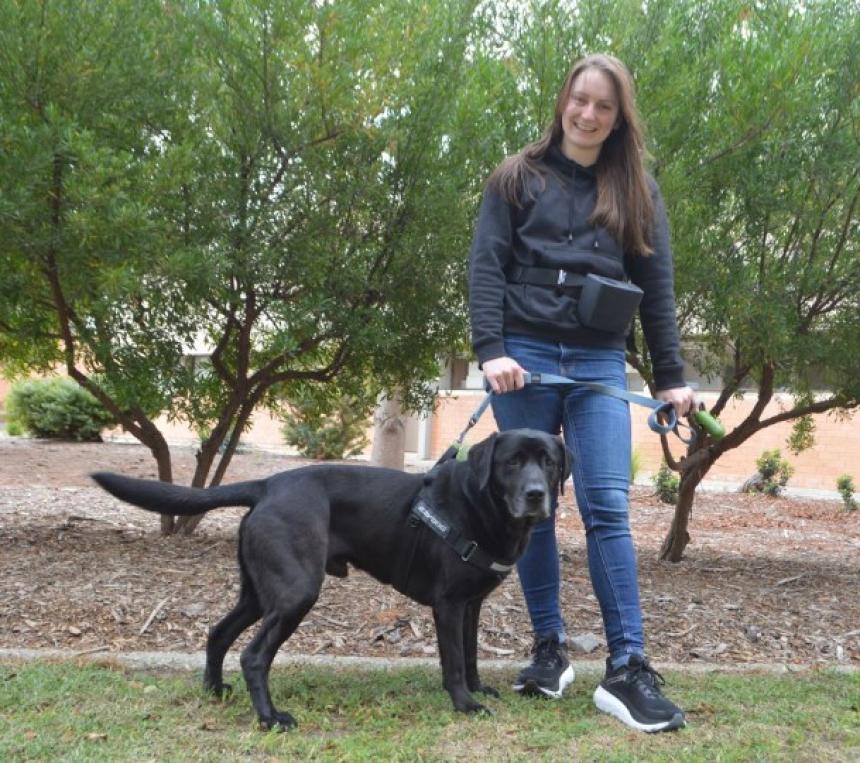
Dr Georgia Moloney
School of Animal and Veterinary Sciences
College of Science
Dr Georgia Moloney is a veterinarian and wildlife conservation scientist leading research on illegal wildlife trafficking through maritime transport routes. Her work aims to develop detection tools which can be used by law enforcement and customs personnel to detect wildlife trafficking attempts and secure the chain of evidence for prosecution. The major themes highlighted through her work include One Health, biodiversity, species conservation, animal welfare, public health, zoonotic disease transmission, biosecurity and policy enforcement.
Dr Georgia Moloney is a veterinarian and wildlife conservation scientist leading research on illegal wildlife trafficking through maritime transport routes. Her work aims to develop detection tools which can be used by law enforcement and customs personnel to detect wildlife trafficking attempts and secure the chain of evidence for prosecution. The major themes highlighted through her work include One Health, biodiversity, species conservation, animal welfare, public health, zoonotic disease transmission, biosecurity and policy enforcement.
| Language | Competency |
|---|---|
| English | Can read, write, speak, understand spoken and peer review |
| Date | Institution name | Country | Title |
|---|---|---|---|
| 2022 - 2026 | The University of Adelaide | Australia | PhD in Animal and Veterinary Sciences |
| 2019 - 2021 | The University of Adelaide | Australia | Doctor of Veterinary Medicine |
| 2016 - 2018 | The University of Adelaide | Australia | Bachelor of Science (Veterinary Bioscience) |
| Date | Title | Institution name | Country |
|---|---|---|---|
| 2022 | Research Training Program Stipend | The University of Adelaide | - |
| Year | Citation |
|---|---|
| 2026 | Moloney, G. K., Heighton, S. P., Parthuisot, N., Missoup, A. D., Momboua, B. R., Djagoun, C. A. M. S., . . . Gaubert, P. (2026). Improving DNA detection sensitivity for the white-bellied pangolin (Phataginus tricuspis) via digital PCR.. Forensic science international. Genetics, 81, 103366. Scopus1 WoS1 |
| 2026 | Moloney, G. K., Shute, N. M., Brien, G. G., Moloney, J., & Chaber, A. -L. (2026). Combining detection dogs with air extraction methodology to expose wildlife trafficking in containerized cargo.. Conservation biology : the journal of the Society for Conservation Biology, 40(4), e70225. Europe PMC1 |
| 2026 | Moloney, G. K., Chaber, A. L., & Hall, T. (2026). Application of headspace solid-phase microextraction gas chromatography mass spectrometry (HS-SPME GC-MS) analysis to support illicit timber trafficking investigations. Wood Science and Technology, 60(3), 17 pages. |
| 2025 | Gillett, M., Moloney, G., & Chaber, A. -L. (2025). Proving Ecocide: The Plight of Pangolins as a Case Study for Fusing Ecological Science with International Law. International Criminal Law Review, 25(1), 1-50. Scopus3 WoS2 |
| 2025 | Moloney, G. K., Brien, G. G., Shute, N. M., Khabiri, A., Moloney, J., Delcheva, I., . . . Chaber, A. -L. (2025). Assessing the viability of airborne environmental DNA detection for identifying trafficked lion pelts (Panthera leo) in a containerised environment. Frontiers in Conservation Science, 6, 1671488-1-1671488-10. Scopus1 WoS2 |
| 2025 | Moloney, G. K., Isafiade, A., Douay, G., Schoppe, S., Meagher, P., Chaber, A. -L., & Hall, T. (2025). Scaling up pangolin detection: Profiling pangolin volatilomes for wildlife forensic investigations.. Forensic Sci Int, 379, 112737. Scopus2 WoS2 |
| 2024 | Moloney, G. K., Warne, R., & Chaber, A. L. (2024). Navigating the complexities of wildlife trade data: Counter-response to Kolby and Reaser Addendum 19 December 2023. One Health, 18, 100705. |
| 2024 | Chaber, A. L., Warne, R., & Moloney, G. K. (2024). Navigating discrepancies in macaque trade reporting: A response to Kolby et al. (2024) and a call for enhanced transparency. One Health, 18, 100687-1-100687-3. Scopus1 WoS1 |
| 2024 | Moloney, G. K., & Chaber, A. -L. (2024). Where are you hiding the pangolins? screening tools to detect illicit contraband at international borders and their adaptability for illegal wildlife trafficking.. PloS one, 19(4), e0299152. Scopus8 WoS7 Europe PMC5 |
| 2023 | Moloney, G. K., Gossé, K. J., Bi, S. G., Gaubert, P., & Chaber, A. -L. (2023). Is Social Media the New Wet Market? Social Media Platforms Facilitate the Online Sale of Bushmeat in West Africa. One Health, 16, 9 pages. Scopus11 WoS10 Europe PMC3 |
| 2023 | Warne, R., Moloney, G. K., & Chaber, A. -L. C. (2023). Is Biomedical Research Demand Driving a Monkey Business?. One Health. |
| 2023 | Warne, R. K., Moloney, G. K., & Chaber, A. -L. (2023). Is biomedical research demand driving a monkey business?. One Health, 16, 10 pages. Scopus17 WoS17 Europe PMC15 |
| 2023 | Moloney, G. K., Chaber, A. -L. C., Renault, V., Morrison-Lanjouw, S., Garigliany, M. -M., Flandroy, L., . . . Gaubert, P. (2023). Examining the International Bushmeat Traffic in Belgium: A Threat to Conservation and Public Health. One Health, 17, 8 pages. Scopus10 WoS9 Europe PMC8 |
| 2023 | Moloney, G. K., Gaubert, P., Gryseels, S., Verheyen, E., & Chaber, A. -L. (2023). Investigating Infectious Organisms of Public Health Concern Associated with Wild Meat. Transboundary and Emerging Diseases, 2023, 1-15. Scopus7 WoS7 Europe PMC7 |
| 2021 | Moloney, G. K., Tuke, J., Dal Grande, E., Nielsen, T., & Chaber, A. -L. (2021). Is YouTube promoting the exotic pet trade? Analysis of the global public perception of popular YouTube videos featuring threatened exotic animals.. PloS one, 16(4), e0235451. Scopus37 WoS32 Europe PMC12 |
| 2020 | Moloney, G., Tuke, J., Dal Grande, E., Nielsen, T., & Chaber, A. -L. (2020). Is YouTube <sup>®</sup> promoting the exotic pet trade? Analysis of the global public perception of popular YouTube <sup>®</sup> videos featuring threatened exotic animals. |
| - | Moloney, G. K., Moloney, J., Lignereux, L., & Chaber, A. -L. (2026). An Adaptable Air Extraction Approach for Detecting Illicit and Hazardous Materials Concealed in Shipping Cargo Containers. World Customs Journal, 20(1). |
| Year | Citation |
|---|---|
| 2026 | Moloney, G., & Chaber, A. -L. (2026). Dogs can detect trafficked wildlife hidden in shipping containers from tiny air samples. DOI |
Connect With Me

External Profiles

Available For Media Comment.