
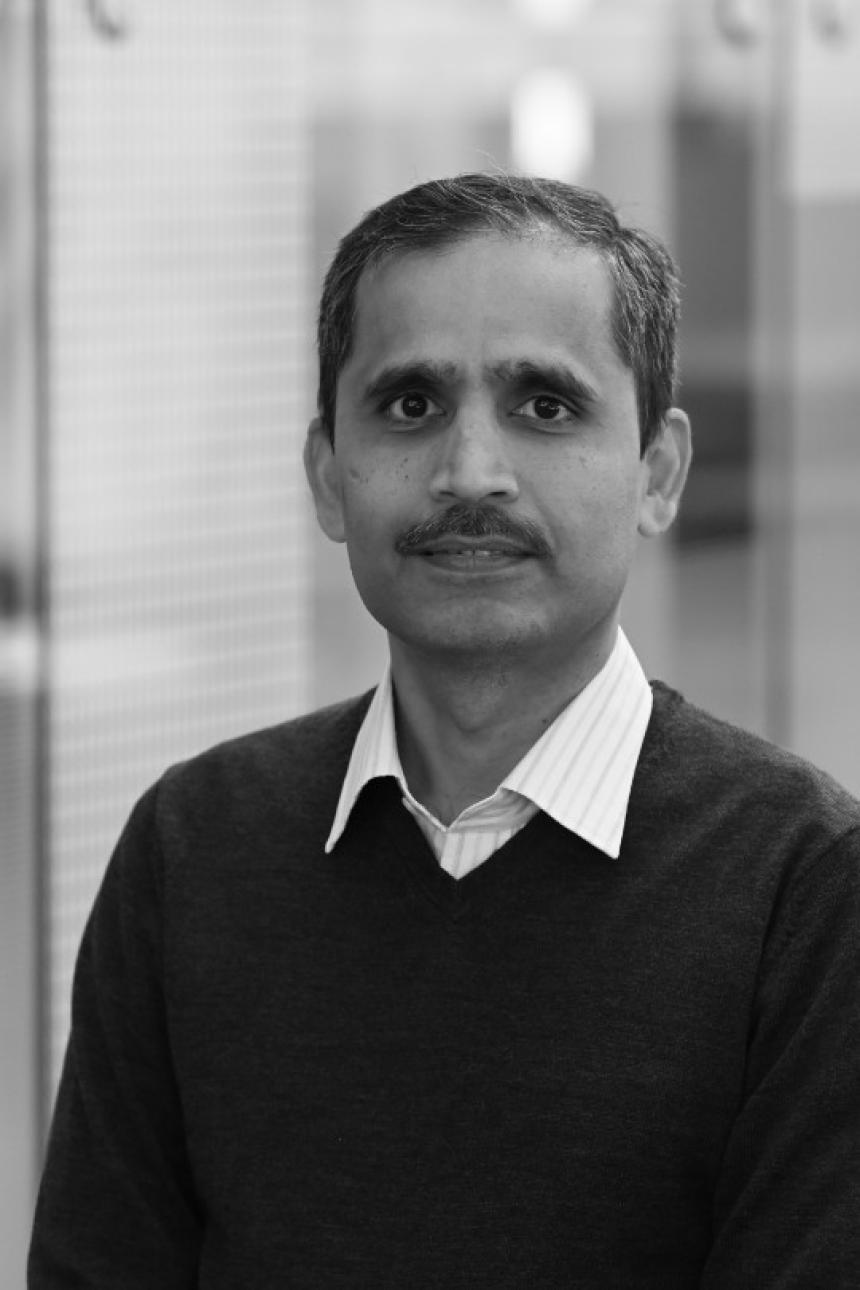
Dr Ganesh Keremane
Research Fellow
School of Law
College of Business and Law
Ganesh is a Research Fellow at the College of Business and Law, specialising in governance systems that support inclusive, resilient, and sustainable transitions. His research examines how institutional arrangements, stakeholder collaboration, and policy frameworks shape effective governance across diverse social and environmental contexts
With a background in water governance and institutional analysis, Ganesh has contributed to multiple interdisciplinary research projects and is skilled in mixed‑methods approaches that generate evidence‑based insights for both academic and policy audiences. He holds a PhD in Business Management and received the CRC Irrigation Futures Directors Award for his research on institutional arrangements for wastewater reuse in Australia and India. He has authored a book and published refereed journal articles, book chapters, and research reports, advancing both academic knowledge and practical policy insights.
Ganesh’s current work centres on governance frameworks that enable the transition to net‑zero precincts. As part of Race for 2030’s Pathways to Net Zero Precincts project, he contributes to research delivery and project management, with a particular focus on the Rundle Mall (Adelaide) case study. His work explores how governance arrangements, stakeholder collaboration, and institutional readiness shape sustainable urban transitions.
In addition to his research, Ganesh serves as an academic mentor to business students, supporting their academic development and fostering an inclusive, encouraging learning environment.
Net Zero Transition Governance
Ganesh’s current work centres on governance frameworks that support the transition to net‑zero precincts. His work examines how governance arrangements, stakeholder collaboration, and institutional readiness shape sustainable urban transitions.
Water Governance Expertise (Past & Ongoing Foundations)
Ganesh’s broader research background is grounded in water governance, with expertise spanning:
- Water institutions and policy analysis
- Collaborative governance approaches
- Community participation and public–private partnerships
- Policy entrepreneurs and institutional change
- Alternative (‘new’) water sources, including community attitudes and perceptions toward wastewater reuse and recycled water
- Qualitative and participatory research methods, including PhotoStory and other visual/engagement-based approaches
These foundations continue to inform his current work on sustainability transitions, particularly in understanding how communities, institutions, and governance systems adapt to emerging environmental challenges.
| Date | Institution name | Country | Title |
|---|---|---|---|
| University of South Australia | Australia | PhD | |
| University of Agricultural Sciences, Dharwad | India | MSc Agri. Economics |
| Date | Title | Institution | Country |
|---|---|---|---|
| PG Diploma in Environmental Law and Policy | National Law University, Delhi | India |
| Year | Citation |
|---|---|
| 2025 | Wu, Z., Keremane, G., Guo, S., & Fu, H. (2025). Exploring the impact of place attachment on residents' preferences for implementing NbS in urban areas: a case of using stormwater recycled through MAR in Taiyuan, China. In R. Shaw (Ed.), Source details - Title: Nature-Based Solutions for Urban and Peri-Urban Areas: For Resilient and Sustainable Urbanization (pp. 253-272). Singapore: Springer Nature. DOI |
| 2023 | Keremane, G. (2023). The wadi sustainable agriculture model. In R. Brears (Ed.), Source details - Title: The Palgrave Encyclopedia of Urban and Regional Futures (pp. 2141-2149). Switzerland: Palgrave Macmillan. DOI |
| 2017 | Keremane, G., McKay, J., & Wu, Z. (2017). Urban water governance for the twenty-first century: a portfolio-based approach to planning and management. In K. Karar, & E. E (Eds.), Source details - Title: Freshwater governance for the 21st century (pp. 103-127). Switzerland: Springer. DOI |
| 2017 | Ettehad, E., McKay, J., & Keremane, G. (2017). Concept of public interest in the Adelaide Desalination Plant delivery: lessons for public policy makers on improving social justice. In A. Lukasiewicz (Ed.), Source details - Title: Natural resources and environmental justice: Australian perspectives (pp. 61-78). Australia: CSIRO Publishing. |
| 2017 | Keremane, G., McKay, J., & Wu, Z. (2017). Urban Water Governance for the Twenty-First Century: A Portfolio-Based Approach to Planning and Management. In E. Karar (Ed.), Global Issues in Water Policy (Vol. 6, pp. 103-127). SPRINGER INTERNATIONAL PUBLISHING AG. DOI Scopus5 WoS7 |
| 2017 | Keremane, G. (2017). Informal and Uncontrolled Use of Wastewater for Agriculture. In GOVERNANCE OF URBAN WASTEWATER REUSE FOR AGRICULTURE: A FRAMEWORK FOR UNDERSTANDING AND ACTION IN METROPOLITAN REGIONS (pp. 93-103). SPRINGER-VERLAG BERLIN. DOI |
| 2017 | Keremane, G. (2017). Urban Wastewater Reuse-A Common Reality. In GOVERNANCE OF URBAN WASTEWATER REUSE FOR AGRICULTURE: A FRAMEWORK FOR UNDERSTANDING AND ACTION IN METROPOLITAN REGIONS (pp. 9-22). SPRINGER-VERLAG BERLIN. DOI WoS1 |
| 2017 | Keremane, G. (2017). Study Design and Methods. In GOVERNANCE OF URBAN WASTEWATER REUSE FOR AGRICULTURE: A FRAMEWORK FOR UNDERSTANDING AND ACTION IN METROPOLITAN REGIONS (pp. 61-69). SPRINGER-VERLAG BERLIN. DOI |
| 2017 | Keremane, G. (2017). Theoretical Framework. In GOVERNANCE OF URBAN WASTEWATER REUSE FOR AGRICULTURE: A FRAMEWORK FOR UNDERSTANDING AND ACTION IN METROPOLITAN REGIONS (pp. 39-60). SPRINGER-VERLAG BERLIN. DOI |
| 2017 | Keremane, G. (2017). Public-Private Partnership Model for Wastewater Management. In GOVERNANCE OF URBAN WASTEWATER REUSE FOR AGRICULTURE: A FRAMEWORK FOR UNDERSTANDING AND ACTION IN METROPOLITAN REGIONS (pp. 71-82). SPRINGER-VERLAG BERLIN. DOI |
| 2017 | Keremane, G. (2017). Water Governance and Wastewater Reuse in Australia and India. In GOVERNANCE OF URBAN WASTEWATER REUSE FOR AGRICULTURE: A FRAMEWORK FOR UNDERSTANDING AND ACTION IN METROPOLITAN REGIONS (pp. 23-37). SPRINGER-VERLAG BERLIN. DOI WoS2 |
| 2017 | Keremane, G. (2017). Private Sector Participation in Wastewater Management. In GOVERNANCE OF URBAN WASTEWATER REUSE FOR AGRICULTURE: A FRAMEWORK FOR UNDERSTANDING AND ACTION IN METROPOLITAN REGIONS (pp. 83-91). SPRINGER-VERLAG BERLIN. DOI |
| 2017 | Keremane, G. (2017). Governance of Urban Wastewater Reuse for Agriculture A Framework for Understanding and Action in Metropolitan Regions Introduction. In GOVERNANCE OF URBAN WASTEWATER REUSE FOR AGRICULTURE: A FRAMEWORK FOR UNDERSTANDING AND ACTION IN METROPOLITAN REGIONS (pp. 1-8). SPRINGER-VERLAG BERLIN. DOI |
| 2017 | Keremane, G. (2017). Lessons Learned and Way Forward. In GOVERNANCE OF URBAN WASTEWATER REUSE FOR AGRICULTURE: A FRAMEWORK FOR UNDERSTANDING AND ACTION IN METROPOLITAN REGIONS (pp. 105-117). SPRINGER-VERLAG BERLIN. DOI |
| 2016 | Wu, Z., & Keremane, G. (2016). Governance of nonconventional water sources: South Australian urban community views on ownership, trust, and pricing. In S. Eslamain (Ed.), Source details - Title: Urban water reuse handbook (pp. 949-957). New York: CRC Press. |
| 2015 | Keremane, G., McKay, J., & Wu, Z. (2015). Public servants as sustainability policy entrepreneurs in Australia: the issues and outcomes. In P. Kyrö (Ed.), Source details - Title: Handbook of entrepreneurship and sustainable development research (pp. 155-176). United Kingdom: Edward Elgar Publishing Ltd. DOI Scopus1 |
| 2015 | Keremane, G. (2015). Role of sustainability policy entrepreneurs in building water-sensitive cities to respond to climate change: a case study in Adelaide, Australia. In S. Shrestha (Ed.), Source details - Title: Managing water resources under climate uncertainty: examples from Asia, Europe, Latin America, and Australia (pp. 359-376). Switzerland: Springer. DOI Scopus1 |
| 2015 | Keremane, G. (2015). Water-sensitive cities to respond to climate change: A case study in Adelaide, Australia. In Managing Water Resources Under Climate Uncertainty Examples from Asia Europe Latin America and Australia (pp. 359-376). DOI Scopus1 |
| 2014 | Wu, Z., McKay, J., & Keremane, G. (2014). Stormwater reuse for sustainable cities: the South Australian experience. In B. Maheshawari (Ed.), Source details - Title: The security of water, food, energy and liveability of cities (Vol. 71, pp. 137-150). US: Springer. DOI WoS1 |
| 2014 | Keremane, G., McKay, J. M., & Wu, Z. (2014). Achieving ecologically sustainable development in multi-level water governance regimes: the case of the Murray-Darling Basin. In M. Kidd (Ed.), Source details - Title: Water and the law: towards sustainability (pp. 211-226). UK: Edward Elgar Publishing. DOI |
| 2010 | Keremane, G. (2010). Urban wastewater reuse and sustainable development. In C. B. Daniels (Ed.), Source details - Title: Adelaide : water of a city (pp. 330-331). Adelaide: Wakefield Press. |
| 2010 | Keremane, G. (2010). Recycling urban wastewater, an alternative source for agricultural irrigation. In C. B. Daniels (Ed.), Source details - Title: Adelaide : water of a city (pp. 340-343). Adelaide: Wakefield Press. |
| 2010 | Keremane, G. (2010). Public-private partnerships. In C. B. Daniels (Ed.), Source details - Title: Adelaide : water of a city (Vol. 88, pp. 26-&). Adelaide: Wakefield Press. |
Courses I teach
- BUSS 2084 Business across Asian Community (2024)
| Date | Role | Research Topic | Program | Degree Type | Student Load | Student Name |
|---|---|---|---|---|---|---|
| 2012 - 2012 | Co-Supervisor | Balancing and crossing trust bridges to sustainability : the case of the water sector reform in Lebanon | Doctor of Philosophy | Doctorate | Part Time | Miss Rim El Kadi |
| 2010 - 2014 | Co-Supervisor | An evaluation of stakeholder engagement methods in a complex forestry-environment-agriculture water conflict - a case study of the Lower Limestone Coast water allocation plan in South Australia | Doctor of Philosophy | Doctorate | Full Time | Miss Chunfang Xu |
Connect With Me

External Profiles


