

Research Interests
Neuroscience, Behaviour and Brain HealthMiss Emmylou Nicolas
Higher Degree by Research Candidate
School of Pharmacy and Biomedical Sciences
College of Health
More than half of individuals affected by rare genetic diseases do not receive a clear genetic diagnosis and, as a result, are unable to access appropriate treatments or targeted interventions that could improve their quality of life. Approximately 15% of genetic diseases are caused by variants that alter RNA splicing. Validating these types of variants typically requires analysis of the patient’s RNA, which is most easily obtained from accessible tissues such as blood or skin. However, 30% or 1,436 Mendelian disease genes are not expressed in these patient accessible materials due to tissue-specific gene expression. For example, most genes implicated in neurodevelopmental disorders are expressed in the brain, making direct analysis using brain tissues highly invasive and often unfeasible.
Emmylou’s research focuses on addressing these challenges and increasing the diagnostic yield for individuals with rare diseases by developing RNA-based tools to functionally assess and validate RNA variants. Her work employs CRISPR-based gene transactivation technologies to activate genes with tissue-specific expression that are normally silent in blood or skin cells. She also applies RNA-capture techniques using biotinylated probes to selectively enrich lowly expressed disease genes, allowing for deeper sequencing coverage in short-read RNA-seq analyses, and thus enabling robust analysis of splicing outcomes. For rare muscular disorders, Emmylou performs cellular transdifferentiation of skin cells into iMyotubes, a skeletal muscle-like cells, to enable expression and analysis of muscle-specific genes. For patients unable to provide blood or skin samples, she combines CRISPR prime editing and CRISPR gene transactivation in easy-to-culture cell lines, such as HEK293T, to recreate patient variants and activate the corresponding disease gene. This approach enables functional validation and potential diagnosis without requiring invasive biopsies.
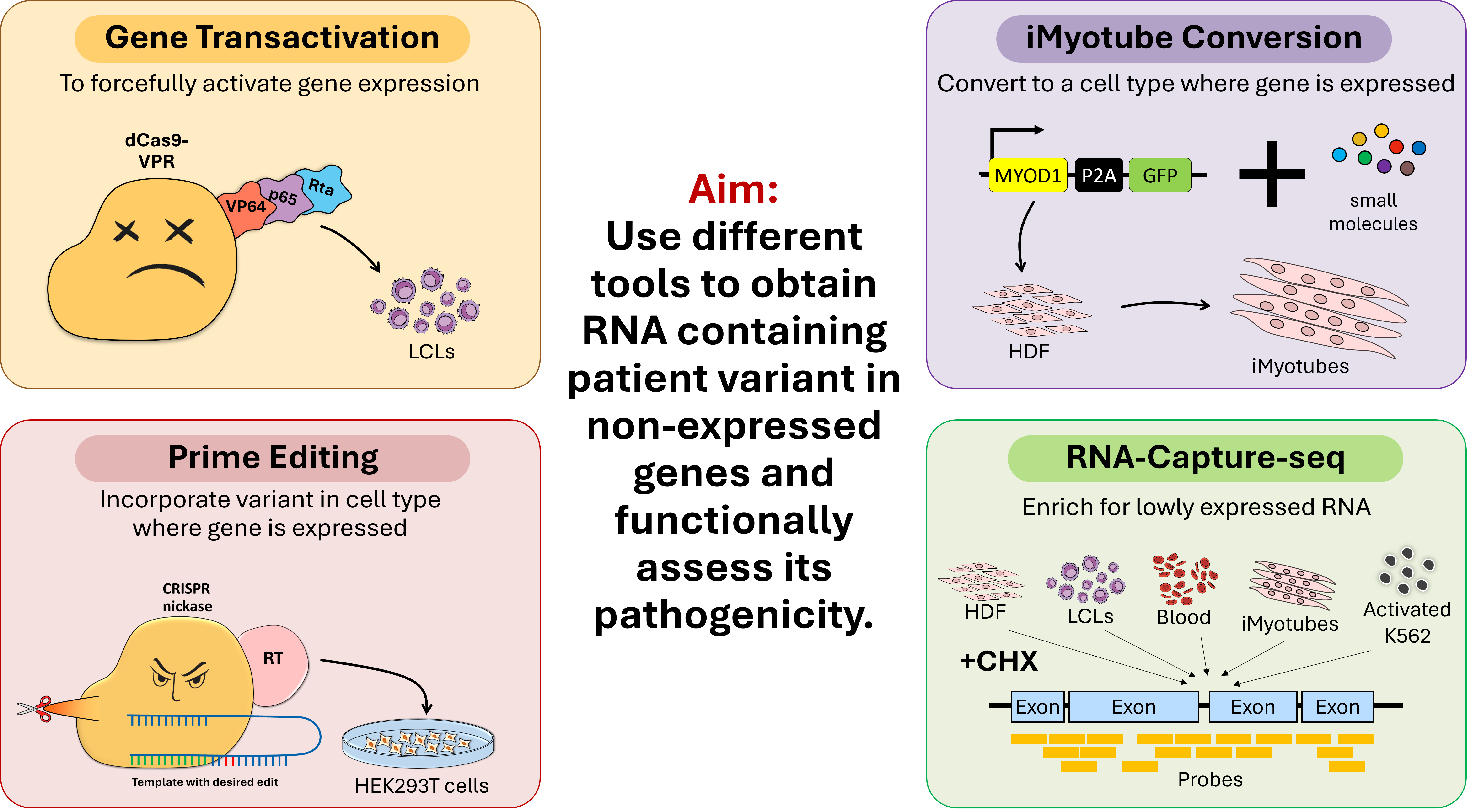
Beyond diagnosis, Emmylou is also interested in developing personalised therapeutic strategies for patients with dominant heterozygous loss-of-function variants. In these cases, one copy of a gene is affected, and the remaining healthy copy is insufficient to maintain normal function. By using CRISPR gene transactivation to upregulate the expression of the healthy allele, Emmylou aims to restore gene dosage and potentially ameliorate disease-associated phenotypes. Ultimately, Emmylou’s work seeks to bridge genetic diagnostics and translational medicine, paving the way for improved diagnosis, understanding, and treatment of rare genetic diseases.
| Date | Position | Institution name |
|---|---|---|
| 2021 - ongoing | Research Assistant | University of Adelaide |
| Date | Type | Title | Institution Name | Country | Amount |
|---|---|---|---|---|---|
| 2026 | Award | Travel Award | Atlas of Variant Effects (AVE) Alliance - 9th Mutational Scanning International Symposium | Australia | $500 |
| 2025 | Award | Best Oral Presentation - Student Category | ANZ Society for Cell and Developmental Biology - 13th SA Meeting | Australia | $200 |
| 2025 | Award | Best Research Image Award | ANZ Society for Cell and Developmental Biology - 13th SA Meeting | Australia | $200 |
| 2025 | Award | Short Talk Award (1st runner-up) | Human Genetics Society of Australasia - 20th SA Symposium | Australia | $500 |
| 2025 | Scholarship | PhD Scholarship | The University of Adelaide | Australia | 100% Tuition Fee Waiver and annual stipend of $35,500 |
| 2024 | Award | Best Poster Presentation – Research Assistant Category | Australian Society for Medical Research - 63rd National Meeting | Australia | $200 |
| 2023 | Award | Best Oral Presentation – Early/Mid-Career Research Category | Human Genetics Society of Australasia - 18th SA Symposium | Australia | $200 |
| 2022 | Award | Best Poster Presentation – Early/Mid-Career Research Category | Human Genetics Society of Australasia - 17th SA Symposium | Australia | $200 |
| 2021 | Award | Best Oral Presentation (1st Runner Up) - Student Category | ANZ Society for Cell and Developmental Biology - 10th SA Meeting | Australia | $200 |
| 2021 | Award | Prize in Master of Biotechnology (Biomedical) | The University of Adelaide | Australia | $500 |
| 2021 | Award | Adelaide Graduate Award | The University of Adelaide | Australia | - |
| 2019 | Scholarship | Global Citizens International Scholarship (2019-2021) | The University of Adelaide | Australia | 15% Tuition Fee Waiver |
| 2016 | Award | Faculty of Science Dean’s Lister | Bicol University | Philippines | - |
| 2013 | Scholarship | Department of Science and Technology-Science Education Institute (DOST-SEI) Scholarship (2013-2016) | Bicol University | Philippines | 100% Tuition Fee Waiver and monthly stipend |
| Date | Institution name | Country | Title |
|---|---|---|---|
| 2019 - 2021 | University of Adelaide | Australia | Master of Biotechnology (Biomedical) |
| 2012 - 2016 | Bicol University | Philippines | Bachelor of Science in Biology |
| Year | Citation |
|---|---|
| 2025 | John, T., Nicolas-Martinez, E. C., Gardner, A., Zhang, J. V., Jolly, L. A., & Gecz, J. (2025). The PERSYST Study: Pathogenic Evaluation of Recalcitrant Variants By Systematic Transactivation. In Abstracts for the 47th Human Genetics Society of Australasia Annual Scientific Meeting, Gold Coast, Queensland, Australia, 10−13 August 2024 Vol. 28. Gold Coast, QLD: Cambridge University Press on behalf of International Society for Twin Studies. DOI |
| 2024 | Gecz, J., Nicolas, E., Corbett, M., Ritchie, T., Scheffer, I., Berkovic, S., . . . Jolly, L. (2024). Novel high throughput functional genomics approaches. In Abstracts of the 56th European Society of Human Genetics Conference (ESHG 2023), as published in European Journal of Human Genetics Vol. 32 (pp. 82-83). Glasgow, Scotland, UK: Springer. DOI |
| 2023 | Jolly, L., Nawaz, U., Nicolas, E., Voineagu, I., & Gecz, J. (2023). Contextual Control of Nonsense-Mediated mRNA Decay by UPF3A. In Twin Research and Human Genetics Vol. 26 (pp. 49-126). Perth, Western Australia: Cambridge University Press. DOI |
| 2023 | Jolly, L., Nicolas, E., Pflueger, C., Lister, R., & Gecz, J. (2023). Transactivation of cell lines for functional genomic studies. In Pathology Vol. 55 (pp. S20). Elsevier BV. DOI |
| Year | Citation |
|---|---|
| 2026 | Nawaz, U., Nicolas-Martinez, E., Montazaribarforoushi, S., Carroll, R., Voineagu, I., Gecz, J., & Jolly, L. (2026). UPF3A and UPF3B shape the transcriptome cooperatively yet oppose cell function. DOI |
Connect With Me

External Profiles
