
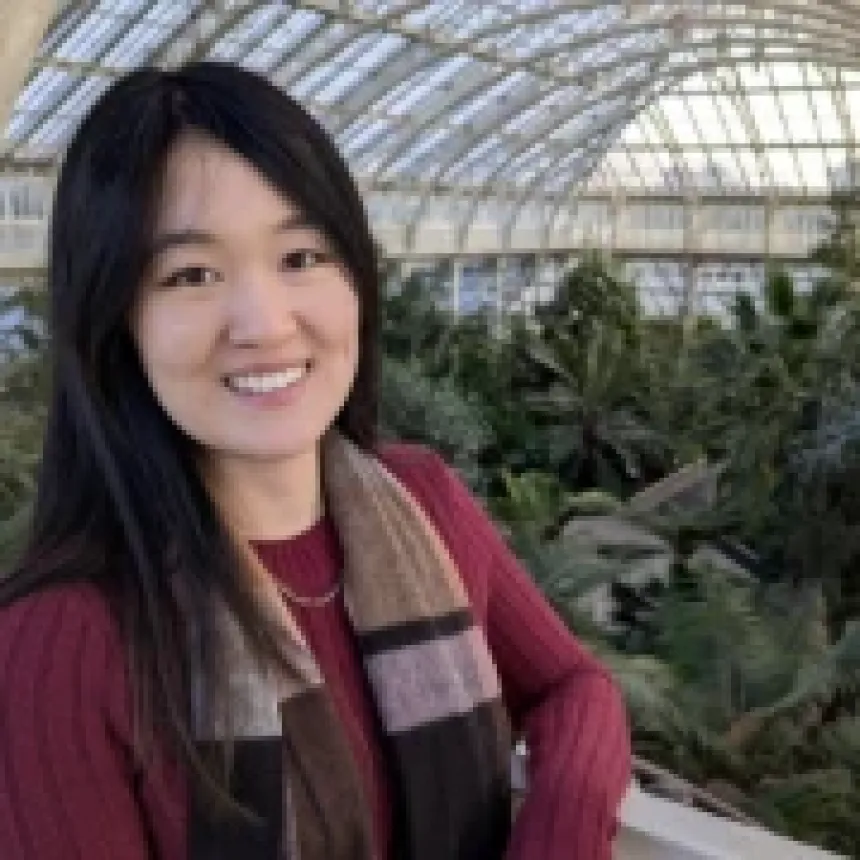
Dr Kylie Yang
Lecturer
School of Physics, Chemistry and Earth Sciences
College of Sciences
Eligible to supervise Masters and PhD (as Co-Supervisor) - email supervisor to discuss availability.
Kylie obtained her PhD on fluorescence sensing at the University of Sydney in 2021 under the supervision of Professor Elizabeth New. This was followed by a postdoctoral position at the University College London working with Dr Cally Haynes on transmembrane ion transport. Kylie returned to Australia to her current role as a Lecturer in the discipline of Chemistry at the University of Adelaide in 2025.
My research focuses on understanding the abnormal chemical reactivity that occurs within diseased microenvironments. By designing new chemical tools, we can develop smart sensors and therapeutics that will specifically react within within target tissue such as solid tumours. This can be used to build activatable sensors and therapeutics that specifically target a feature associated with disease. To do this, we aim to identify unique reactive chemical species that are found within diseased tissue that are absent in normal tissue. Our goal is to build sensors and therapeutics that exploit this difference in chemical reactivity for selective disease targeting.
My projects aim to develop:
- Activatable drug carriers and drug conjugates that target solid tumours
- Fluorescent probes for imaging cancer biomarkers
- High-throughput screening methods to identify antimicrobial and cytotoxic agents
- Probes for super-resolution microscopy
If you are interested in discussing any of these projects or working together, please come by my office or drop me an email!
Contact information:
Office: Badger 230
email: kylie.yang@adelaide.edu.au
| Date | Position | Institution name |
|---|---|---|
| 2025 - ongoing | Lecturer in Medicinal Chemistry | University of Adelaide |
| 2021 - 2025 | Postdoctoral Research Associate | University College London |
| Date | Institution name | Country | Title |
|---|---|---|---|
| 2021 | University of Sydney | Australia | PhD |
| Year | Citation |
|---|---|
| 2026 | Yang, K., Marsh, C., White, L. J., Molyneux, F. W., Allam, T. L., Popoola, P. I. A., . . . Haynes, C. J. E. (2026). An increased throughput workflow to identify ion transport and membrane lysis agents for antimicrobial discovery.. Chemical science. |
| 2026 | Popoola, P. I. A., Allam, T. L., Lilley, R. J., Manwani, C., Keers, O. B., Tan, J., . . . Hiscock, J. R. (2026). Amino acid appended supramolecular self-associating amphiphiles demonstrate dual activity against both MRSA and ovarian cancer.. Chemical science. |
| 2025 | Yang, K., Lee, L. C., Kotak, H. A., Morton, E. R., Chee, S. M., Nguyen, D. P. M., . . . Haynes, C. J. E. (2025). High‐Throughput and Automated Anion Transport Assays. Chemistry–Methods, 5(8), 5 pages. WoS3 |
| 2022 | Yang, K., Boles, J. E., White, L. J., Hilton, K. L. F., Lai, H. Y., Long, Y., . . . Haynes, C. J. E. (2022). A water-soluble membrane transporter for biologically relevant cations. RSC Advances, 12(43), 27877-27880. Scopus5 WoS4 Europe PMC4 |
| 2022 | Yang, K., Kotak, H. A., & Haynes, C. J. E. (2022). Metal-organic ion transport systems. Coordination Chemistry Reviews, 470, 214705. Scopus15 WoS14 |
| 2022 | Yang, K., Pavic, K., Bowyer, A. A., Manolios, N., & New, E. J. (2022). Supplementing clinical diagnostics of erosive joint diseases with bio-inspired ratiometric sensors. Frontiers in Sensors, 3. |
| 2021 | Lin, J., Yang, K., & New, E. J. (2021). Strategies for organelle targeting of fluorescent probes. Organic and Biomolecular Chemistry, 19(43), 9339-9357. Scopus69 WoS70 Europe PMC43 |
| 2020 | Leslie, K. G., Kolanowski, J. L., Trinh, N., Carrara, S., Anscomb, M. D., Yang, K., . . . New, E. J. (2020). Nicotinamide-appended fluorophores as fluorescent redox sensors. Australian Journal of Chemistry, 73(10), 895-902. Scopus3 WoS2 |
| 2018 | Müllner, M., Yang, K., Kaur, A., & New, E. J. (2018). Aspect-ratio-dependent interaction of molecular polymer brushes and multicellular tumour spheroids. Polymer Chemistry, 9(25), 3461-3465. Scopus47 WoS47 |
| 2018 | Yang, K., Leslie, K. G., Kim, S. Y., Kalionis, B., Chrzanowski, W., Jolliffe, K. A., & New, E. J. (2018). Tailoring the properties of a hypoxia-responsive 1,8-naphthalimide for imaging applications. Organic and Biomolecular Chemistry, 16(4), 619-624. Scopus27 WoS27 Europe PMC15 |
| 2017 | Graziotto, M. E., Akerfeldt, M. C., Gunn, A. P., Yang, K., Somerville, M. V., Coleman, N. V., . . . New, E. J. (2017). The influence of the ethane-1,2-diamine ligand on the activity of a monofunctional platinum complex. Journal of Inorganic Biochemistry, 177, 328-334. Scopus11 WoS11 Europe PMC7 |
| 2017 | Yang, K., Kolanowski, J. L., & New, E. J. (2017). Mitochondrially targeted fluorescent redox sensors. Interface Focus, 7(2), 14 pages. Scopus27 WoS26 Europe PMC17 |
| 2017 | Wu, A., Kolanowski, J. L., Boumelhem, B. B., Yang, K., Lee, R., Kaur, A., . . . Rendina, L. M. (2017). A Carborane-Containing Fluorophore as a Stain of Cellular Lipid Droplets. Chemistry an Asian Journal, 12(14), 1704-1708. Scopus30 WoS30 Europe PMC13 |
| Year | Citation |
|---|---|
| 2017 | Kaur, A., Lim, Z., Yang, K., & New, E. J. (2017). Fluorescent Sensors for Biological Metal Ions. In Comprehensive Supramolecular Chemistry II (Vol. 8, pp. 295-317). Elsevier. DOI Scopus8 |
| Year | Citation |
|---|---|
| 2025 | Popoola, P., Allam, T., Lilley, R., Manwani, C., Keers, O., Tan, J., . . . Hiscock, J. (2025). Amino acid appended supramolecular self-associating amphiphiles demonstrate dual activity against both MRSA and ovarian cancer. DOI |
| 2024 | Yang, K., Lee, L., Kotak, H., Morton, E., Chee, S. M., Nguyen, D., . . . Haynes, C. (2024). High-throughput and Automated Anion Transport Assays. DOI |
Medicinal and Biological Chemistry II
Connect With Me

External Profiles

