
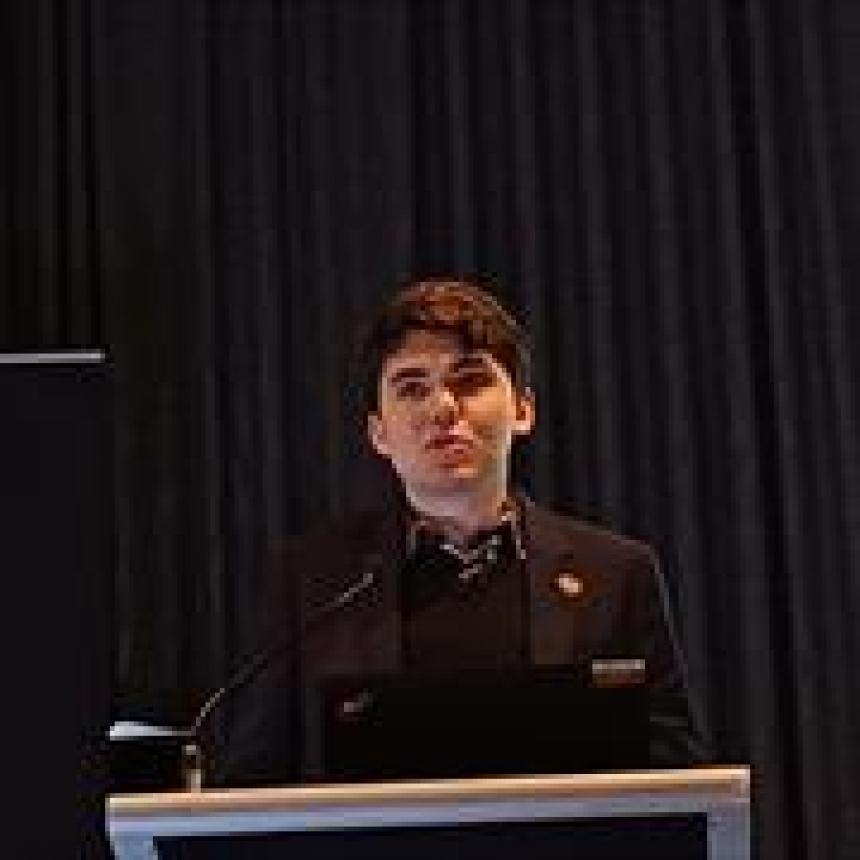
Mr Jayden Squire
Higher Degree by Research Candidate
School of Physics, Chemistry and Earth Sciences
College of Sciences
I am a PhD student in isotope Geochemistry, under the supervison of Juraj Farkas, Stein Jacobsen and Bruno Riberio. My PhD focus points are related to Rb-Sr and K-Ca dating of impact structures, along with Cr isotope tracing of source impactors using meteoritic reference material. I am also exploring how K isotopes behave during terrestrial impacts, the implications of that on planetary building impacts. On top of my PhD research, I am involved with the The Galileo Project @ Harvard University through providing samples for comparative analysis with found samples from the site of CNEOS 2014-01-08.
I am also interested in anything related to Planetary Science and Cosmochemistry, and open to collaboration in this space.
The specific research aims and techniques to be used by this PhD are:
1) Coupled Rb-Sr and K-Ca geochronology of selected craters or impact structures located in Australia and Europe, including i) The Acraman Crater in South Australia, which currently has an estimated age of around 580 million years (Ma)(Willaims and Gostin, 2005), ii) the Gardnos Crater located in Norway which has an estimated age between ~500 to 600 Ma (French et al 1997). Hence, the Acraman and Gardnos impacts both likley occurred within the Ediacaran period, and thus there is a possibility that they being correlated or coeval, possibly representing a single ‘impact cluster’ event. This hypothesis will be tested via coupled Rb-Sr and K-Ca geochronology of sampled ejecta materials or meltrocks from these impact sites in South Australia and Norway.
2) The Cr isotope variations of impact materials from Acraman and Gardnos, complemented also by a set of meteorites (from the Tate Museum at University of Adelaide), will be analyzed to trace possible sources for the impactors. Specifically,53Cr/52Cr ratios can help us to trace the source impactor (type of meteorite) of the selected craters (Anand et al 2023). Briefly, the radioactive decay 53Mn/53Cr isotopic system (Shukolyukov and Lugmair 1998), along with elemental abundance ratios (e.g. Cr/Ni) can be used to constrain the source impactor (Anand et al 2023). In addition to data of source meteorites collected from the literature, this project will also undertake Cr isotope analyses on unique extraterrestrial samples from the extensive meteorite collection in the Tate Museum.
3) Finally, to test the volatility and sensitivity of K isotopes during terrestrial impact structures, a case study will be done using the Acraman and Gardnos meltrocks, and comparing their K isotope signatures (41K/39K ratios) with those in the impacted source rocks (e.g. Gawler craton igneous rocks, Gardons area basement rocks) to quantify and model the volatile loss of potassium (based on K isotopes) during the high-energy impact events, with implications for their paleo-temperature/pressure conditions. Such volatile loss of K and associated isotope fractionation during giant impacts has been demonstrated recently for the Moon forming ‘giant’ impact (Wang and Jacobsen 2016) and therefore possible volatile loss of K might be expected during major high-pressure/temperature terrestrial impacts.


From September 2025 I have become involved with the The Galileo Project @ Harvard University, through providing samples for comparative analysis of collected microtektites from the site of CNEOS 2014-01-08 impact. The first output of this collaboration is now available online.
| Date | Type | Title | Institution Name | Country | Amount |
|---|---|---|---|---|---|
| 2025 | Award | Barringer Award | Meteoritical Society | Australia | 600USD |
| 2024 | Award | GSA Honours Endowement Award | Geological Society of Australia | Australia | $1000 |
| Date | Institution name | Country | Title |
|---|---|---|---|
| 2021 - 2024 | University of Adelaide | Australia | Honours Degree of Bachelors of Science |
| Year | Citation |
|---|---|
| 2025 | Squire, J., Farkas, J., Verdel, C., & Loyola, C. (2025). GOSSES BLUFF REVISISTED: Geochronology, Impactor Type and Shock Petrography. Poster session presented at the meeting of METEORITICS & PLANETARY SCIENCE. AUSTRALIA, Perth: WILEY. |
| 2024 | Squire, J., Farkas, J., Verdel, C., & Loyola, C. (2024). Rb-Sr thermochronology of the Gosses Bluff (Tnorala) impact structure, central Australa. Poster session presented at the meeting of Australian Space Research Conference. Sydney. |
| 2024 | Squire, J., Farkas, J., Verdel, C., & Loyola, C. (2024). IN SITU RB-SR DATING OF THE GOSSES BLUFF (TNORALA) IMPACT STRUCTURE IN CENTRAL AUSTRALIA. Poster session presented at the meeting of Earth Sciences Student Symposium, South Australia. University of Adelaide, South Australia. |
| 2023 | Squire, J., & Milnes, A. (2023). AUSTRALITES BEARING LOCALITIES AND COLLECTIONS IN SOUTHERN AUSTRALIA AND THEIR ROLE IN STRATIGRAPHY. Poster session presented at the meeting of Earth Sciences Student Symposium, South Australia. Flinders University, South Australia. |
| Year | Citation |
|---|---|
| 2024 | Squire, J. (2024). Honours Thesis: In situ Rb-Sr dating of the Gosses Bluff (Tnorala) impact structure in central Australia. (Undergraduate Dissertation, University of Adelaide). |
| Year | Citation |
|---|---|
| 2025 | Hyung, E., Levy, E., Cook, L., Jacobsen, S., Loeb, A., Squire, J., & Farkas, J. (2025). Comparison of Australasian tektites with BeLaU-type spherules recovered from the Pacific Ocean Site of the CNEOS 2014 January 8 (IM1) Bolide. |
| Squire, Farkas, Jacobsen | Meteoritical Society Research Grants | USD$2800 | 2025 | https://meteoritical.org/news/five-new-meteoritical-society-research-grants-awarded |
| Date | Role | Board name | Institution name | Country |
|---|---|---|---|---|
| 2024 - ongoing | Board Member | National Board | Mars Society of Australia | Australia |
| 2024 - 2025 | Representative | Student Representative Council | University of Adelaide | Australia |
Connect With Me

External Profiles
