
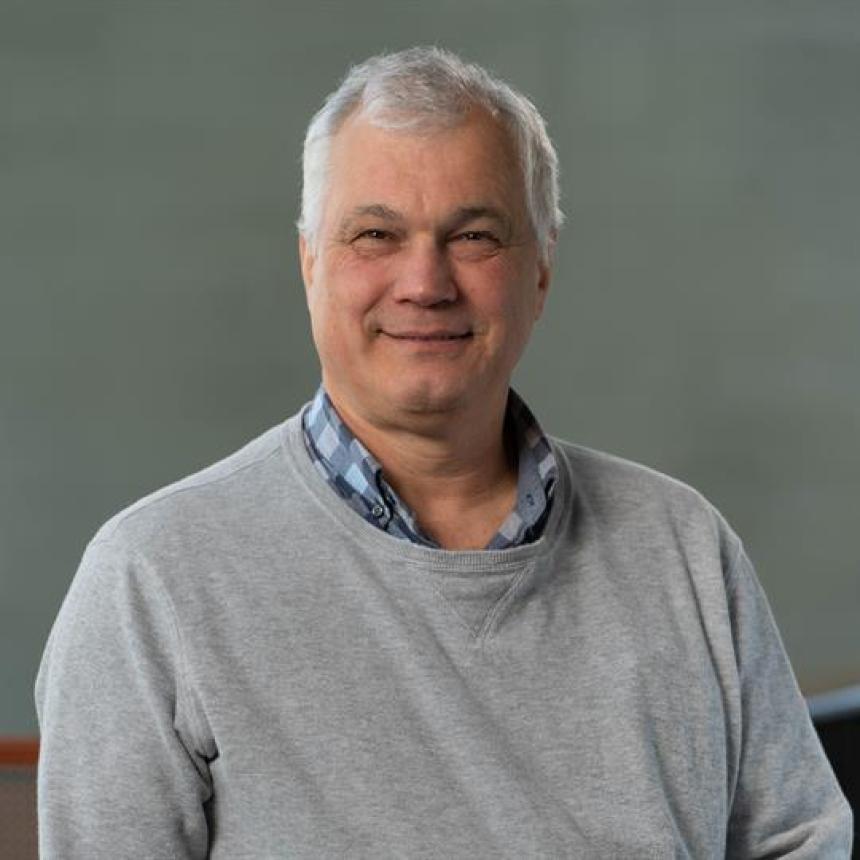
Prof Nigel Spooner
Grant-Funded Research Professor
School of Physics, Chemistry and Earth Sciences
College of Science
Eligible to supervise Masters and PhD - email supervisor to discuss availability.
Professor Nigel Spooner was awarded a DPhil (Physics, Oxon) in 1993, following which he relocated to establish and head the “Luminescence Dating Laboratory” (LDL) at RSES, Australian National University, Australia. Research focussed on environmental dosimetry utilising luminescence induced in artificial and naturally-occurring environmental materials by ionising radiation from natural and man-made sources in the environment. Work included elucidation of the physics and phenomenology of thermoluminescence (TL) and optically-stimulated luminescence (OSL) from these materials for dosimetry, the development of Luminescence Dating (TL & Optical Dating) protocols, and the invention of apparatus for environmental dosimetry research and application. Devices included the world’s first commercially-manufactured Optical Dating system, including luminescence readers, automated alpha particle and beta particle irradiators and specialised calibration facilities, in collaboration with Littlemore Scientific Engineering (Elsec), Oxfordshire, UK. Applications included the use of TL and Optical Dating for “retrospective dosimetry” (Dose Reconstruction) in the modern era. A key focus of the LDL was reaching into past times using radiometric dating: Optical Dating in particular had “broken through” to gain recognition as a major new chronological technique. This enabled the team to address major questions in geomorphology, soil science, palaeohydrology, archaeology and palaeontology, leading to numerous publications including cover articles in the journals Nature and Science.Nigel transferred to DST Group in 2002, from where he initiated the joint DST Group-University of Adelaide Luminescence program from 2004. This was later incorporated as a founding element of the successful Institute for Photonics and Advanced Sensing (IPAS), and was renamed the “The Prescott Environmental Luminescence Laboratory” (PELL). The PELL boasts a globally-unique suite of instruments for luminescence analysis, radiation exposure detection and radiometric dating. Activity areas include retrospective dosimetry, radiation detection technology development including a novel class of radiation-sensitive optical fibres and single-sand-grain Optical Dating apparatus, TL research, and environmental radioisotope and dose-rate measurement. The laboratory possesses world-leading technology, hosting the most sensitive TL spectrometer, and the world’s most sensitive radiogenic luminescence imaging technology for spatially-resolved OSL & TL imaging.Nigel's innovation and research leadership has broadened since 2014 from Radiation S&T and Luminescence Dosimetry & Geochronology to since also focus on the key new research field of “Novel Fluorescence (NF)”. In 2013 in response to the absence of field-deployable technologies capable of real time mineral species-specific identification in mining and mineral processing, he initiated the “Novel Fluorescence” research program for material-specific characterisation. This commenced with funding from CRC Optimising Resource Extraction (CRC ORE), pioneering new photonics technology for material detection, identification and quantification for mining and mineral processing. The facility includes integrated multiple synchronised laser excitation systems and UV to MWIR spectral detection, enabling “Upconversion Fluorescence” (UF) and “conventional” single-photon fluorescence to be analysed in unstudied or little-studied regimes of excitation & emission wavelength and temperature. It is now the world’s-leading laboratory pioneering “novel” forms of fluorescence for resource discovery and selective mining in both the terrestrial and off-Earth contexts. The huge potential of the NF discoveries is leading to multiple opportunities for commercialisation (spin-out, www.TeraGlo.io) and is expected to have significant real-world impact. These include sensors for asbestos, lithium ore (spodumene), phosphate minerals, heavy minerals and key REE’s. The Defence “Next Generation Technology Fund” has supported research into sensing explosives and chemicals, and the Australian Space Agency supports NF for real-time non-contact sensors capable of mineral species discrimination deployment for in situ Space Resource Assessment & Utilisation. NF identifies mineral and organic species rather than their component elements, including tiny proportions of target materials in complex environments, which will be critical for future resource assessment in the off-Earth environment and for subsequent remote mineral processing and manufacturing control.
From 2015 I have attracted more than $32M in research funding. This included roles as two Chief Investigator on 2 x ARC Research Training Centres, 1x ARC Research Hub, 2 x Cooperative Research Centre and 1 x CRC-P projects and $5M from Defence programs. I have successfully secured research facility funding and fostered collaboration with various industries, including mining and mineral processing, Defence and National Security (CBRN), and health and medical, resulting in successful research programs leading to publications, HDR student graduations and commercialisation endeavours. I am the University of Adelaide lead for the new Australian Research Council Industrial Transformation Training Centre “RadInnovate” (IC230100036), a 5-year Centre partnering ANU & UniSA and commencing in 2024; my role is Pillar Lead for “Radiation Innovation”, one of three Pillars in this ITTC, and Principal/Co-Supervisor of 6-8 ITTC RadInnovate HDR students.
My innovation and research leadership focused on the following three key areas: “Novel Fluorescence (NF)”, Radiation S&T and Luminescence Dosimetry & Geochronology:
Novel Fluorescence: I am the pioneer to use new photonics technology for material detection, identification and quantification using “Upconversion fluorescence” (UF). The Prescott Environmental Luminescence Laboratory” (PELL) has integrated multiple synchronised UV to MIR-tuneable OPO laser excitation systems, with cryogenic-to-elevated temperature sample stages and UV to MWIR detection, now enabling both UF and “conventional” single-photon fluorescence to be analysed in little-studied regimes of wavelength and temperature. Since 2015 this has grown to be the world’s leading facility for these novel approach to fluorescence materials sensing.
Radiation S&T: PELL houses world-leading luminescence detection apparatus for kinetics analysis, TL spectral analysis and Photon-counting Imaging, and developmental technologies in novel radiation sensitive optical fibres for alpha and beta particle detection, drone-borne radiation field intensity sensors, and extensive capability for naturally-source radiopharmaceutical radioisotope extraction, from natural sources such as radioactive mine waste. Spinning-off from the PELL’s leading regional capability, in 2019 I created the industry-focussed Centre for Radiation Research, Education and Innovation (CRREI) as a radiation-focussed centre also delivering radiation education courses targeting a critical skills gap. CRREI is now expanding into radiation biology for health, Defence and Space purposes.
Luminescence Dosimetry & Geochronology: The PELL’s unique research suite includes the world-leading “3D-TL” Spectrometer and Photon Counting Imaging System (PCIS), along with nine Risoe OSL/TL readers, state of the art beta counters, twelve alpha spectrometers, seven HPGe gamma ray spectrometers, alpha particle detection technology and calibrated alpha, beta and photon irradiation facilities. These support an extensive Single-grain Optical Dating program applied to both academic collaboration and fee-for service SG-OSL dating.
| Date | Position | Institution name |
|---|---|---|
| 2019 - ongoing | Founder, Deputy Director | ARC Training Centre for Radiation and Innovation (CRREI) |
| 2018 - ongoing | Professor, Physics | University of Adelaide |
| 2009 - 2018 | Adjunct Professor, Luminescence | University of Adelaide |
| 2002 - 2018 | Senior Research Scientist | Defence Science and Technology Group (DSTG) |
| 1993 - 2002 | Head, Luminescence Laboratory | Institute of Advanced Studies (IAS), Australian National University (ANU) |
| Date | Type | Title | Institution Name | Country | Amount |
|---|---|---|---|---|---|
| 2023 | Award | Secretary's Award for Long Service | Australian Public Service | Australia | - |
| 2007 | Award | First DSTG-University Joint Professorship | The University of Adelaide | Australia | - |
| Language | Competency |
|---|---|
| English | Can read, write, speak, understand spoken and peer review |
| Date | Institution name | Country | Title |
|---|---|---|---|
| 2009 | University of Melbourne | Australia | Graduate Certificate in Scientific Leadership (1st class) |
| 1993 | University of Oxford | United Kingdom | DPhil |
| 1987 | University of Adelaide | Australia | MSc |
| 1980 | University of Adelaide | Australia | BSc Hons |
| Year | Citation |
|---|---|
| 2024 | Doughney, T., Gillam, J., Kalnins, C., Hooker, A. M., Marinaro, D., Damas, D., . . . Spooner, N. A. (2024). GEANT4 Surface Model for Background Radiation in Complex Environments. In 2022 IEEE NSS/MIC RTSD - IEEE Nuclear Science Symposium, Medical Imaging Conference and Room Temperature Semiconductor Detector Conference Vol. 784 (pp. 1-2). Italy: IEEE. DOI |
| 2024 | de Prinse, T., Moffatt, J., Payten, T., Slattery, T., Rusby, J., Tsiminis, G., . . . Spooner, N. A. (2024). Novel fluorescence analysis for real-time moon mineralogy. In Y. Soskind, & L. E. Busse (Eds.), Photonic Instrumentation Engineering XI Vol. 12893 (pp. 66). Online: SPIE. DOI Scopus1 |
| 2020 | Chapsky, A., Spooner, N. A., Santos, A., & Rutten, T. (2020). 3D dose distribution measurement using 2D imaging from NaCl optical crystals. In Proceddings of the Micro-Mini & Nano Dosimetry and Innovative Technologies in Radiation Oncology (MMND ITRO 2020), as published in Journal of Physics: Conference Series Vol. 1662 (pp. 012009-1-012009-4). online: IOP Publishing. DOI |
| 2017 | Hunter, P., & Spooner, N. (2017). Investigation of the role of the production process on the luminescence of sea salt products. In Geochronometria Vol. 44 (pp. 121-128). Adelaide, AUSTRALIA: DE GRUYTER OPEN LTD. DOI |
| 2014 | Warren-Smith, S., Tsiminis, G., Robertson, I., Turnbull, G., Samuel, I., Spooner, N., & Monro, T. (2014). Fabrication of subwavelength surface gratings on exposed-core microstructured optical fibres. In International Conference on Nanoscience and Nanotechnology. Adelaide, South Australia. |
| 2014 | Tsiminis, G., Rowland, K., Ebendorff-Heidepriem, H., Spooner, N., & Monro, T. (2014). Extruded single ring hollow core optical fibers for Raman sensing. In J. LopezHiguera, J. Jones, M. LopezAmo, & J. Santos (Eds.), Proceedings of SPIE - The International Society for Optical Engineering Vol. 9157 (pp. 915782-1-915782-4). US: SPIE. DOI Scopus1 WoS2 |
| 2014 | Chu, F., Tsiminis, G., Spooner, N., & Monro, T. (2014). Explosives sensing based on suspended core fiber coated with conjugated polymer. In J. LopezHiguera, J. Jones, M. LopezAmo, & J. Santos (Eds.), Proceedings of SPIE - The International Society for Optical Engineering Vol. 9157 (pp. 915784-1-915784-4). US: SPIE. DOI |
| 2013 | Chu, F., Tsiminis, G., Lang, C., Spooner, N., & Monro, T. (2013). Measuring nitroaromatic explosives using polymer-coated microstructured optical fibers. In Australian and New Zealand Conference on Optics and Photonics. Fremantle, W.A.. |
| 2013 | Tsiminis, G., Chu, F., Spooner, N., & Monro, T. (2013). Sensing explosives with suspended core fibers: Identification and quantification using Raman spectroscopy. In Proceedings of SPIE vol 8627 Vol. 8627 (pp. 86270M-1-86270M-7). Online: SPIE. DOI Scopus2 |
| 2012 | Kalnins, C., Ebendorff-Heidepriem, H., Spooner, N., & Monro, T. (2012). Optically stimulated luminescence in fluoride phosphate glass optical fibres for radiation dosimetry. In Proceedings Volume 8351, Third Asia Pacific Optical Sensors Conference Vol. 8351 (pp. 83512G-1-83512G-6). US: SPIE. DOI Scopus1 WoS1 |
| 2012 | Tsiminis, G., Spooner, N., & Monro, T. (2012). Raman detection of hydrogen peroxide in suspended core optical fibers. In Proceedings of SPIE Vol. 8421 (pp. 842181). US: SPIE. DOI |
| 2010 | Prescott, J., Creighton, D., Williams, F., & Spooner, N. (2010). Three-Dimensional luminescence spectra of single grains of feldspar. In Proceedings of 16th AINSE conference on nuclear and complementary techniques of analysis (pp. 1-4). online: 16th AINSE conference on nuclear and complementary techniques of analysis. |
| 2009 | Kalnins, C., Ebendorff-Heidepriem, H., Monro, T., Williams, F., & Spooner, N. (2009). Radiation effects in glasses for optical fiber dosimetry. In Proceedings of the ACOLS ACOFT 09 Conference (pp. 26-27). CDROM: Australian Optical Society. |
| 2008 | Spooner, N. A., & Smith, B. W. (2008). Luminescence analysis for radiological and nuclear forensic application. In E Forensics 2008 Proceedings of the 1st International Conference on Forensic Applications and Techniques in Telecommunications Information and Multimedia and Workshop. ACM. DOI Scopus1 |
| 1997 | Abeyratne, M., Spooner, N. A., Grün, R., & Head, J. (1997). Multidating studies of Batadomba Cave, Sri Lanka. In Quaternary Science Reviews Vol. 16 (pp. 243-255). AUSTRALIAN NATL UNIV, CANBERRA, AUSTRALIA: PERGAMON-ELSEVIER SCIENCE LTD. DOI Scopus18 WoS16 |
| 1994 | Roberts, R. G., Jones, R., Spooner, N. A., Head, M. J., Murray, A. S., & Smith, M. A. (1994). The human colonisation of Australia: optical dates of 53,000 and 60,000 years bracket human arrival at Deaf Adder Gorge, Northern Territory. In Quaternary Science Reviews Vol. 13 (pp. 575-583). KREMS, AUSTRIA: PERGAMON-ELSEVIER SCIENCE LTD. DOI Scopus275 WoS233 |
| 1994 | Visocekas, R., Spooner, N. A., Zink, A., & Blanc, P. (1994). Tunnel afterglow, fading and infrared emission in thermoluminescence of feldspars. In Radiation Measurements Vol. 23 (pp. 377-385). KREMS, AUSTRIA: PERGAMON-ELSEVIER SCIENCE LTD. DOI Scopus91 WoS90 |
| 1994 | Spooner, N. A. (1994). The anomalous fading of infrared-stimulated luminescence from feldspars. In Radiation Measurements Vol. 23 (pp. 625-632). KREMS, AUSTRIA: PERGAMON-ELSEVIER SCIENCE LTD. DOI Scopus310 WoS286 |
| 1994 | Spooner, N. A. (1994). On the optical dating signal from quartz. In Radiation Measurements Vol. 23 (pp. 593-600). KREMS, AUSTRIA: PERGAMON-ELSEVIER SCIENCE LTD. DOI Scopus253 WoS241 |
| 1992 | Spooner, N. A. (1992). Optical dating: Preliminary results on the anomalous fading of luminescence from feldspars. In Quaternary Science Reviews Vol. 11 (pp. 139-145). CLERMONT FERRAND, FRANCE: PERGAMON-ELSEVIER SCIENCE LTD. DOI Scopus118 WoS108 |
| 1990 | Smith, B. W., Rhodes, E. J., Stokes, S., & Spooner, N. A. (1990). The optical dating of sediments using quartz. In Radiation Protection Dosimetry Vol. 34 (pp. 75-78). VIENNA, AUSTRIA: NUCLEAR TECHNOLOGY PUBL. DOI Scopus50 WoS53 |
| 1990 | Spooner, N. A., Aitken, M. J., Smith, B. W., Franks, M., & McElroy, C. (1990). Archaeological dating by infrared-stimulated luminescence using a diode array. In Radiation Protection Dosimetry Vol. 34 (pp. 83-86). VIENNA, AUSTRIA: NUCLEAR TECHNOLOGY PUBL. DOI Scopus89 WoS88 |
| Year | Citation |
|---|---|
| 2021 | Tran, Q. D., Spooner, N., Geoghegan, S., Stoudemire, J., Tran, N. N., Fisk, I., & Hessel, V. (2021). Cosmic-ray Irradiation Study of a Space Medicine for Future On-Orbit Manufacturing. Poster session presented at the meeting of Luxembourg Space Resources Week 2021. Luxembourg. DOI |
| Year | Citation |
|---|---|
| 2018 | Spooner, N., & Ottaway, D. (2018). ARC Australian Copper-Uranium Transformational Research Hub Fifth Sponsors Review Report. |
| 2018 | Spooner, N. A., & Ottaway, D. (2018). ARC Australian Copper-Uranium Transformational Research Hub Sixth Sponsors Review Report. |
| 2018 | Spooner, N. A., & Ottaway, D. J. (2018). ARC Australian Copper-Uranium Transformational Research Hub Status Update Report - Feb 2018. |
| 2018 | Spooner, N. A., & Ottaway, D. (2018). ARC Australian Copper-Uranium Transformational Research Hub 2018 Hub Objectives. |
| 2017 | Spooner, N. A., & Ottaway, D. (2017). ARC Australian Copper-Uranium Transformational Research Hub 2017 Hub Objectives. |
| 2017 | Spooner, N. A., & Ottaway, D. (2017). ARC Australian Copper-Uranium Transformational Research Hub Third Six Monthly Report. |
| 2017 | Spooner, N., & Ottaway, D. (2017). ARC Australian Copper-Uranium Transformational Research Hub Fourth Sponsors Review Report. |
Research Funding
| Date | Project/ No. | Investigators | Funding Body | Amount |
|---|---|---|---|---|
| 2024-2029 | ARC Training Centre for Radiation Innovation | M Dasgupta, E Bezak, G Lane, N Spooner, ...I Williams | ARC ITTC | $4,990,000 |
| 2024 | Rapid development of new medical treatment compounds from radioactive mine waste | D Questiaux, M Thewlis, N Spooner, T Payten, J Builth-William, H Wescombe-Down | Australia's Economic Accelerator Seed Grants | $196,248 |
| 2023-2025 | Hand-Portable Real-Time Non-Contact Fluorescence-based Asbestos Sensor | N Spooner, M Lumasag, C Singla, E Schartner | Business Research and Innovation Initiative – Regulatory Technology Round | $969,690 |
| 2022-2025 | Development of the GenX Betavoltaic Battery Pilot Manufacturing Process |
N Spooner, C Kalnins, A Chapsky | DIIS - CRC-P | $949,492 |
| 2022-2022 | Hand-Portable In-situ Real-Time Non-Contact Asbestos Sensor |
N Spooner, M Lumasag, R Loughan, M Vestel, S Gromitsaris | Business Research and Innovation Initiative – Regulatory Technology Round | $87,983 |
| 2021-2022 | Novel fluorescence sensing of materials for Moon to Mars in-situ resource utilisation | N Spooner, A Birbeck | Moon to Mars: Demonstrator Feasibility Grants | $248,404 |
| 2021-2021 | Natural values assessment and conservation monitoring of Naracoorte Caves | E Reed, L Arnold, N Spooner, J Conran, E Fagan-Jeffries | Australian Heritage Grants | $199,869 |
| 2021 | Fluorescence for real-time field identification of minerals | MinEX CRC Project | MinEX CRC Project | $95,000 |
| 2020-2025 | Aboriginal rock art and cultural heritage management in Cape York Peninsula | L Wallis, H Burke, N Spooner, N Cole | ARC Linkage Project | $48,000 |
| 2020-2026 | ARC Training Centre for Integrated Operations for Complex Resources | P Dowd, ..N Spooner | ARC ITTC | $5,625,664 |
| 2020 | Ultrafast Laser Spectroscopy Facility | S Trevor, ...N Spooner, D Abbott | ARC LIEF | $235,960 |
| 2019 | Real-time fluorine mineral identification using novel fluorescence technology | L Moore, N Spooner, D Ottaway, G Tsiminis, J Moffatt | CRC for Optimising Resource Extraction | $631,138 |
| 2018-2023 | Naracoorte Caves: a critical window on faunal extinctions and past climates | L Arnold, R Hill, E Reed, A Cooper, J Austin, J Tibby | ARC Linkage Project | $669,000 |
| 2017-2018 | A regional optical dating facility for South Australia | L Arnold, N Spooner, G Prideaux, R Hill, A Collins | ARC LIEF | $410,000 |
| 2016-2019 | Upconversion Fluorescence for Real-time Mineral Identification | N Spooner, D Ottaway | Cooperative Research Centre for Optimising Resource Extraction (CRC ORE) | $1,300,000 |
| 2015-2020 | ARC Research Hub for Graphene Enabled Industry Transformation | D Losic, E Skafidas, M Majumder, C Fumeaux, N Choudhury, A Nirmalathas, M McLaughlin, J Ma, R Ghomashchi, YL Zhong, M Muzzin, G Anderson, I Neering, N Spooner, H Zhu, K Koziol, A Pollard, A Merkoçi, L Dai, J Liu, R Stewart, S Bohm | Australian Research Council (ARC), Industrial Transformation Research Hubs,IH150100003 | $2,611,346 |
| 2015-2017 | A 140,000 year insight into the imprint of climate and humans on Australia | J Tibby, P Moss, M Leng, J Shakun, N Spooner | Australian Research Council (ARC), Discovery Project, DP150103875 | $381,140 |
| 2015 | Single-Grain Sorter and Loader | NA Spooner, B Cazzolato, D Creighton, L Arnold, M Demuro, D Questiaux | University of Adelaide, Institute for Photonics and Advanced Sensing (IPAS), Pilot Project | $16,000 |
| 2014 | UV to mid-infrared fluorescence spectrometer for use in mineral analysis, radiation dosimetry, and laser materials characterisation | DG Lancaster, H Ebendorff-Heidepriem, MJ Withford, SR Grano, NA Spooner | Australian Research Council (ARC), Linkage Infrastructure, Equipment and Facilities (LEIF), LE140100042 | $360,000 |
| 2013-2018 | The Australian Copper-Uranium Transformation Research Hub | S Grano, D Ottaway, Y Ngothai, P Ashman, H Ebendorff-Heidepriem, A Hooker, J Brugger, S Wilson, A Pring, P Hayes, Y Peng, J Vaughan, E Jak, K Ehrig, N Spooner, S Simons | Australian Research Council (ARC), Industrial Transformation Research Hub, IH130200033 | $2,526,617 |
| 2012 | Upgrade of “Risø” automated reader for single-grain optical dating & radiation dosimetry research | N Spooner | University of Adelaide, Research Equipment and Infrastructure Round | $20,300 |
| 2012 | Small optical and lab apparatus for single-grain optical dating and luminescence radiation dosimetry research | N Spooner | University of Adelaide, Research Equipment and Infrastructure Round | $18,250 |
| 2012 | Low-level K, U, Th and daughter radionuclide measurements for dose rate research | N Spooner | Australian Institute of Nuclear Science and Engineering (AINSE) Award, No ALNGRA12125 | $15,350 |
| 2011-2014 | Transformational diagnostics | TM Monro, A Cooper, LA Salamonsen, RJ Norman, NA Spooner | Australian Research Council (ARC), Super Science Fellowships, FS110200009 | $835,200 |
| 2009 | Risø reader for luminescence imaging & dosimetry | N Spooner | University of Adelaide, Institute for Photonics and Advanced Sensing (IPAS), Equipment Round | $175,000 |
| 2008 | Establishment of Institute of Photonics and Advanced Sensing (IPAS) | Team led by TM Monro | Higher Education Endowment Fund, Federal Department of Education, Employment and Workplace Relations, University of Adelaide, SA State Government and DST Group | $97M |
| Date | Role | Research Topic | Program | Degree Type | Student Load | Student Name |
|---|---|---|---|---|---|---|
| 2025 | Principal Supervisor | Detecting asbestos accurately and reliably using Novel Fluorescence and machine learning to enable on-site identification by end users in a range of environments. | Doctor of Philosophy | Doctorate | Full Time | Mr Miroslav Barta |
| 2025 | Principal Supervisor | Detecting asbestos accurately and reliably using Novel Fluorescence and machine learning to enable on-site identification by end users in a range of environments. | Doctor of Philosophy | Doctorate | Full Time | Mr Miroslav Barta |
| 2024 | Co-Supervisor | CSI Superbugs: Unveiling unique fingerprints of antibiotic-resistant microbes through light | Doctor of Philosophy | Doctorate | Full Time | Ms Harriet Jane Cooling |
| 2024 | Principal Supervisor | Novel Fluorescence of heavy minerals for terrestrial and space applications | Doctor of Philosophy | Doctorate | Full Time | Mr Joshua Grant Rusby |
| 2024 | Principal Supervisor | Novel Fluorescence of heavy minerals for terrestrial and space applications | Doctor of Philosophy | Doctorate | Full Time | Mr Joshua Grant Rusby |
| 2024 | Co-Supervisor | CSI Superbugs: Unveiling unique fingerprints of antibiotic-resistant microbes through light | - | Doctorate | Full Time | Ms Harriet Jane Cooling |
| 2024 | Co-Supervisor | CSI Superbugs: Unveiling unique fingerprints of antibiotic-resistant microbes through light | Doctor of Philosophy | Doctorate | Full Time | Ms Harriet Jane Cooling |
| 2023 | Principal Supervisor | Plastic scintillator design and optimisation for UAV borne gamma radiation surveys | Doctor of Philosophy | Doctorate | Full Time | Mr Aithan Roufos |
| 2023 | Principal Supervisor | Quantification of radionuclide geo-sequestration in minerals surrounding nuclear waste storage facilities | Doctor of Philosophy | Doctorate | Full Time | Mr Jason Alexander Charlwood |
| 2023 | Principal Supervisor | Plastic scintillator design and optimisation for UAV borne gamma radiation surveys | Doctor of Philosophy | Doctorate | Full Time | Mr Aithan Roufos |
| 2023 | Principal Supervisor | Quantification of radionuclide geo-sequestration in minerals surrounding nuclear waste storage facilities | Doctor of Philosophy | Doctorate | Full Time | Mr Jason Alexander Charlwood |
| 2022 | Principal Supervisor | Material Detection Using Novel Luminescence | Doctor of Philosophy | Doctorate | Full Time | Mr Thomas Michael Slattery |
| 2022 | Principal Supervisor | Material Detection Using Novel Luminescence | Doctor of Philosophy | Doctorate | Full Time | Mr Thomas Michael Slattery |
| 2021 | Principal Supervisor | Drone borne Gamma radiation detection for stand-off high resolution surveying of radionuclide concentrations | Doctor of Philosophy | Doctorate | Part Time | Mr Timothy Doughney |
| 2021 | Principal Supervisor | Drone borne Gamma radiation detection for stand-off high resolution surveying of radionuclide concentrations | Doctor of Philosophy | Doctorate | Part Time | Mr Timothy Doughney |
| 2020 | Principal Supervisor | Zircon Auto-Regeneration Luminescence (ZARL) dating using single grain imaging. | Doctor of Philosophy | Doctorate | Part Time | Miss Kathryn Leah McDonnell |
| 2020 | Principal Supervisor | Zircon Auto-Regeneration Luminescence (ZARL) dating using single grain imaging. | Doctor of Philosophy | Doctorate | Part Time | Miss Kathryn Leah McDonnell |
| Date | Role | Research Topic | Program | Degree Type | Student Load | Student Name |
|---|---|---|---|---|---|---|
| 2021 - 2025 | Co-Supervisor | Towards the Development of a Protein Based Gold Biosensor | Doctor of Philosophy | Doctorate | Full Time | Mr Akhil Kumar |
| 2019 - 2022 | Principal Supervisor | New Fluorescence Sensors for Critical Materials | Doctor of Philosophy | Doctorate | Full Time | Mr Thomas Bede Payten |
| 2019 - 2022 | Principal Supervisor | Real-time Fluorine Mineral Detection using Novel Fluorescence Technology | Master of Philosophy | Master | Full Time | Mr Lewis Da Silva Teixeira |
| 2018 - 2020 | Co-Supervisor | Advanced Radiation Sensing Techniques | Master of Philosophy | Master | Full Time | Mr Jarrah Lionel Herbert Mik |
| 2018 - 2020 | Principal Supervisor | The Characterisation of NaCl Crystal for a Reusable Radiation Dosimeter | Doctor of Philosophy | Doctorate | Full Time | Ms Alexandra Chapsky |
| 2018 - 2024 | Principal Supervisor | A Dual Tuneable-Laser Excitation System for the Discovery of Naturally Occurring Fluorescence Signals | Doctor of Philosophy | Doctorate | Part Time | Mr Thomas Jacob de Prinse |
| 2015 - 2020 | Principal Supervisor | Novel Fluorescence Techniques for Real-Time Mineral Identification | Doctor of Philosophy | Doctorate | Full Time | Jillian Elizabeth Moffatt |
| 2014 - 2018 | Principal Supervisor | Radiation Sensitive Optical Fibres for Radiation Detection and Dosimetry | Doctor of Philosophy | Doctorate | Full Time | Carly Anne Whittaker |
| 2014 - 2019 | Principal Supervisor | A Systematic Study of Quartz Thermoluminescence for Forensic and Retrospective Dosimetry | Master of Philosophy | Master | Part Time | Mr Peter Geoffrey Hunter |
| 2011 - 2014 | Principal Supervisor | Testing the TT-OSL Single-Aliquot Protocol for Quartz Sediment Dating | Master of Philosophy | Master | Full Time | Jillian Elizabeth Moffatt |
| 2010 - 2015 | Co-Supervisor | Radiation Effects in Glasses for Intrinsic Optical Fibre Radiation Dosimetry | Doctor of Philosophy | Doctorate | Full Time | Dr Chris Kalnins |
| Date | Role | Committee | Institution | Country |
|---|---|---|---|---|
| 2020 - 2024 | Member | Technical Capability Working Group | Australian Radioactive Waste Agency | Australia |
| 2015 - 2018 | Member | SA Radiation Protection Committee | SA Government | Australia |
| 2015 - ongoing | Chair | Fourth Asia-Pacific Luminescence and ESR Dating Conference (APLED) | - | Australia |
| 2011 - ongoing | Chair | Session Chair, 13th International Conference on Luminescence and Electron Spin Resonance Dating | - | Poland |
| 2010 - ongoing | Chair | Session Chair, 16th International Conference on Solid State Dosimetry | - | Australia |
| 2007 - ongoing | Member | Technical Capability Working Group | Australian Radioactive Waste Agency | Australia |
| 2007 - ongoing | Member | Australian Critical Minerals Research Centre | Australian Critical Minerals Research Centre | Australia |
| 2007 - ongoing | Member | SA EPA Radiation Protection Committee | SA EPA Radiation Protection Committee | Australia |
Connect With Me

External Profiles

